Can an LLM judge score creativity?
Human review of generated creative output is slow and expensive, so the obvious move is to put a model in the reviewer's seat and score everything automatically. On factual tasks that substitution has a clear validation path: run the judge against items with known answers and measure how often it gets them right. Creative work removes that path, because there is no known answer to measure against. What remains is agreement with human reviewers, and human reviewers on creative work disagree with each other by a wide and measurable margin. This piece works through what that leaves a judge able to settle.
Key takeaways
- A judge on a factual task is validated against a gold answer. Creative scoring has no gold answer, so the only available reference is human judgement, which itself disagrees substantially.
- In a HumanSignal benchmark across 7,817 segments, automated judges agreed with a human expert between 45.2% and 57.9% of the time, against roughly 72% for two experts with each other.
- On the DesignPref design comparisons the gap narrows without closing: a personalized judge reached 60.16% against a human pool whose own Krippendorff's alpha was 0.248.
- Judges already stand in for people more often than the literature admits. In a census of preference-data papers, 184 of 364 excluded records used only an automated scorer as their preference signal, and just 160 of 407 core papers re-validated a judge against fresh human judgement.
- Use a judge for triage, coverage, and regression detection against a fixed set. Do not use one to settle whether creative quality moved.
What validating a judge normally requires
The standard procedure has three parts: assemble items whose correct answers are established independently of the judge, run the judge, and measure agreement with those answers. If agreement is high enough for the decision at hand, the judge is fit for that purpose. The whole procedure rests on the first part, a reference standard that exists whether or not anyone runs a model against it.
This works for extraction, classification, transcription, and factual question answering. It also works for aspects of creative output that have objective components, such as whether a requested element is present or whether text is legible at a stated size. In those cases the judge is doing detection rather than evaluation.
Why creative scoring breaks that
There is no gold answer behind the judgement
When the question is which of two layouts reads better, there is no key. The human judgements are themselves the thing you are trying to capture, so grading a judge against them is not the same operation as grading it against the truth. Any accuracy figure here is really an agreement figure wearing different clothes, and reading it as accuracy overstates what has been established.
The human reference itself disagrees
The reference is not merely unavailable, it is internally divided. Research on designer preference data reports a Krippendorff's alpha around 0.248 across a pool of professional designers, with the disagreement treated as brand-specific judgement rather than annotation error. A judge cannot agree with a population that does not agree with itself. At best it can agree with a chosen aggregate, which is a narrower and more arbitrary target than "correct."
What the measurements show
Judges against a human expert
HumanSignal ran a quality estimation benchmark with Custom.MT across 7,817 translation segments, 17 language pairs, and 191 tasks, comparing six automated systems against professional linguists. The judges agreed with a human expert less often than the experts agreed with each other: between 45.2% and 57.9%, against roughly 72% linguist to linguist.
The per-system detail is more useful than the headline. Claude Sonnet 4 detected 88.3% of errors while capturing 27.8% of the available benefit, at 63.9% overall accuracy. Systems that captured more benefit let more errors through. That trade is the practical shape of judge deployment: you choose which error you would rather make, and no setting removes the choice. Translation quality is not design quality, and the specific figures will not transfer, but the ordering is the part that does.
Judges against a plural human population
Design comparisons show the same pattern with the numbers compressed. On the DesignPref data, the best personalized judge reached 60.16% while zero-shot GPT-5 reached 57.70%, against a designer pool at alpha 0.248. Personalization helped, which is itself informative: the judge improved by modeling a specific person's taste rather than by getting closer to a universal standard, because no universal standard was available to get closer to.
Read those together and the ceiling is visible. A judge scoring creative output performs in the high fifties to low sixties against a human reference, in a regime where two humans manage roughly seventy. That is useful, and it is not adjudication.
One caution about interpreting these figures. An agreement rate near sixty percent on a binary comparison is closer to chance than it first appears, since a coin reaches fifty. The margin a judge is adding over guessing is therefore small in absolute terms, and it shrinks further on the subset of comparisons where humans themselves split evenly. Those near-tie comparisons are also the ones teams most want resolved, which means judge performance is weakest precisely where the demand for it is strongest.
Where a judge is still worth running
Triage and coverage
A judge can score everything, which no human panel can. Use it to rank a large output pool so human attention lands on the items most likely to matter, and to maintain continuous coverage between human review cycles. Here a middling agreement rate is acceptable, because the cost of a mistake is a misordered queue rather than a wrong decision.
Regression detection against a fixed set
Run the judge repeatedly over an unchanged reference set and watch its scores over time. Because the set does not change, a shift in judge scores is evidence that something moved, even when the absolute scores are unreliable. This pairs directly with the work of deciding whether quality moved at all, where the judge supplies the alert and humans supply the verdict.
Criteria with objective components
Decompose your rubric and route the objective parts to the judge. Presence of a requested element, contrast ratios, text legibility, aspect conformance, and prompt adherence are all checkable. Reserve the criteria that carry taste for people. This is the most reliable value a judge delivers on creative work, and it comes from the decomposition rather than from the model.
Where it is not
Do not use a judge to settle whether creative quality regressed, to accept or reject work at a quality gate, or to generate preference data that trains a reward model without human re-validation.
The quality-gate case deserves its own warning. A gate applies a threshold to every item, which converts the judge's disagreement with humans into systematic rejection of a particular kind of work rather than into random noise. Whatever the judge undervalues gets filtered out consistently, and because the filtered items never reach a human, nobody observes the pattern. A ranking that is merely imprecise becomes a selection pressure once you put a cutoff on it.
That last one is where the field is drifting. In a HumanSignal census of preference-data literature, 184 of 364 excluded records carried only an off-the-shelf scorer or model judge as their "preference" signal, which is why they were excluded from a corpus about human preference. Within the core corpus, 76 of 407 papers mix model or synthetic labels into human preference data, and only 160 of 407 re-validate a judge against fresh human judgement. Training a model on judge output and then evaluating it with the same judge produces a number that rises while the thing it claims to measure does not.
How to deploy one without overtrusting it
Establish your human baseline first, because a judge cannot be interpreted without it. Have two qualified reviewers independently score the same batch, measure how far they agree, and treat that as the ceiling. Then measure the judge against the same batch. A judge below your human-to-human rate is an instrument for narrowing attention, not for deciding.
Control the known failure modes rather than assuming they are absent. Position, verbosity, and self-enhancement bias are documented behaviours of model judges, and the mitigations are procedural: randomize presentation order, blind the judge to which system produced an output, and avoid scoring a model with a judge from the same family. Recalibrate on a schedule, since provider-side model updates change judge behaviour without notice. Finally, keep the judge's scores separate from human scores in storage rather than merging them into one column, so you never lose track of which judgements a person made. The discipline of scoring outputs with no single right answer depends on that separation more than on any single model choice.
Run the judge and the human review in one loop
A judge earns its place when it widens coverage and a human settles the decisions that matter, which requires both to run against the same rubric and the same reference set. Label Studio Enterprise supports model-assisted scoring, per-criterion rubrics, multi-reviewer assignment, and agreement analytics in one workflow, so the judge's output and the human baseline stay comparable. Take a look at the platform if you are standing this up now.
Can an LLM judge replace human reviewers for creative work?
Not for decisions, on the current evidence. In a HumanSignal benchmark, judges agreed with a human expert between 45.2% and 57.9% of the time, below the roughly 72% two experts achieved with each other, which means the judge is a noisier instrument than the people it would replace. It can replace human attention on the large fraction of items where nothing interesting is happening, which is where most review time goes.
How do I validate a judge when there is no right answer?
Measure the judge against your own human baseline rather than against an absolute standard, and establish that baseline first by having two qualified reviewers score the same batch independently. The judge's agreement with humans is only interpretable relative to the humans' agreement with each other. Re-run both on a fixed reference set periodically, because a judge drifts when the provider updates the model.
Which creative criteria can a judge score reliably?
The ones with objective components: presence of requested elements, prompt adherence, contrast and legibility, aspect ratio and format conformance, and detectable artifacts. These are detection tasks with checkable answers, so a judge can be validated on them normally. Criteria involving composition, brand fit, or craft judgement are where agreement falls, and those are the ones to route to people.
How often should a judge be recalibrated against humans?
Monthly works for most teams, plus an immediate recalibration whenever the provider ships a model update or you change the prompt or rubric. The check is inexpensive: re-score a fixed reference set of 100 to 300 items with both the judge and human reviewers and compare against the previous round. A judge that has drifted usually shows it first on routine items rather than on hard ones.
Does a jury of several models fix the problem?
It reduces some single-model idiosyncrasies such as self-enhancement bias, and it does not create a reference standard where none exists. Several models trained on overlapping data tend to share biases, so their agreement can look like reliability while reflecting common ancestry. Treat a jury as variance reduction on the judge, not as a substitute for human calibration.
What agreement rate should I require before trusting a judge?
There is no portable threshold, because the meaningful comparison is against your own human-to-human rate rather than against a fixed number. If your reviewers agree 70% of the time and the judge agrees with them 55% of the time, the judge is usable for ranking and unusable for deciding. Set the bar by what the decision costs if it is wrong.
Related Content
-
How to build a red teaming dataset
Learn how to build a red teaming dataset with a reusable schema, three sourcing tiers, expert annotation, and a maintenance workflow that keeps your model's safety coverage current.
-
How to Set up AI Evaluation Pipelines in a Machine Learning Workflow
Evaluation pipelines turn model testing into a repeatable habit, making performance changes and failure patterns easier to catch early.
-

Few‑Shot Learning: Train AI with Just a Few Examples
Few‑shot learning empowers AI systems to generalize from only a handful of labeled samples. It's a game-changer for settings with limited data, slashing resource needs and accelerating deployment.
-
Step-by-step guide to AI evaluation in machine learning projects
A structured evaluation workflow helps you move from raw metrics to confident decisions about model quality, risk, and readiness.
-

Best AI evaluation platforms with collaboration features for teams
Once evaluation involves multiple reviewers and stakeholders, permissions, review workflows, and audit trails matter as much as the metrics.
-
Automated metrics vs human evaluation: when each is the right choice
Automated metrics provide scale and consistency, while human evaluation captures nuance, effective AI evaluation programs rely on both.
-
How to Evaluate AI Models Effectively
AI model evaluation isn’t just about accuracy. Learn how to evaluate your models across key dimensions like reliability, bias, and real-world performance.
-
The Complete Guide to Evaluations in AI
Evaluating an AI model isn’t just about checking accuracy, it’s about building trust. This guide explores the full spectrum of evaluation methods, from metrics to human-in-the-loop reviews and LLM-based scoring.
-
ReCode Robustness Evaluation of Code Generation Models: What It Is and Why It Matters
What happens when a code generation model sees slightly modified inputs? ReCode is a benchmark designed to evaluate exactly that—how robustly these models handle variation in the wild.
-
How to Choose Evaluation Metrics for Accuracy and Speed
The right evaluation metrics make accuracy–speed tradeoffs visible so you can optimize for what actually matters in production.
-
Why Explainability Matters in AI Evaluation
This blog explores how explainability and interpretability fit into AI evaluations, helping teams build trust, spot hidden flaws, and ensure ethical performance.
-

AI Evaluation for NLP: What to Use (and When)
NLP evaluation often needs more than automated scores. This guide explains three common tool paths—structured human review, app-layer LLM evaluation, and programmable scoring—and when each fits best.
-
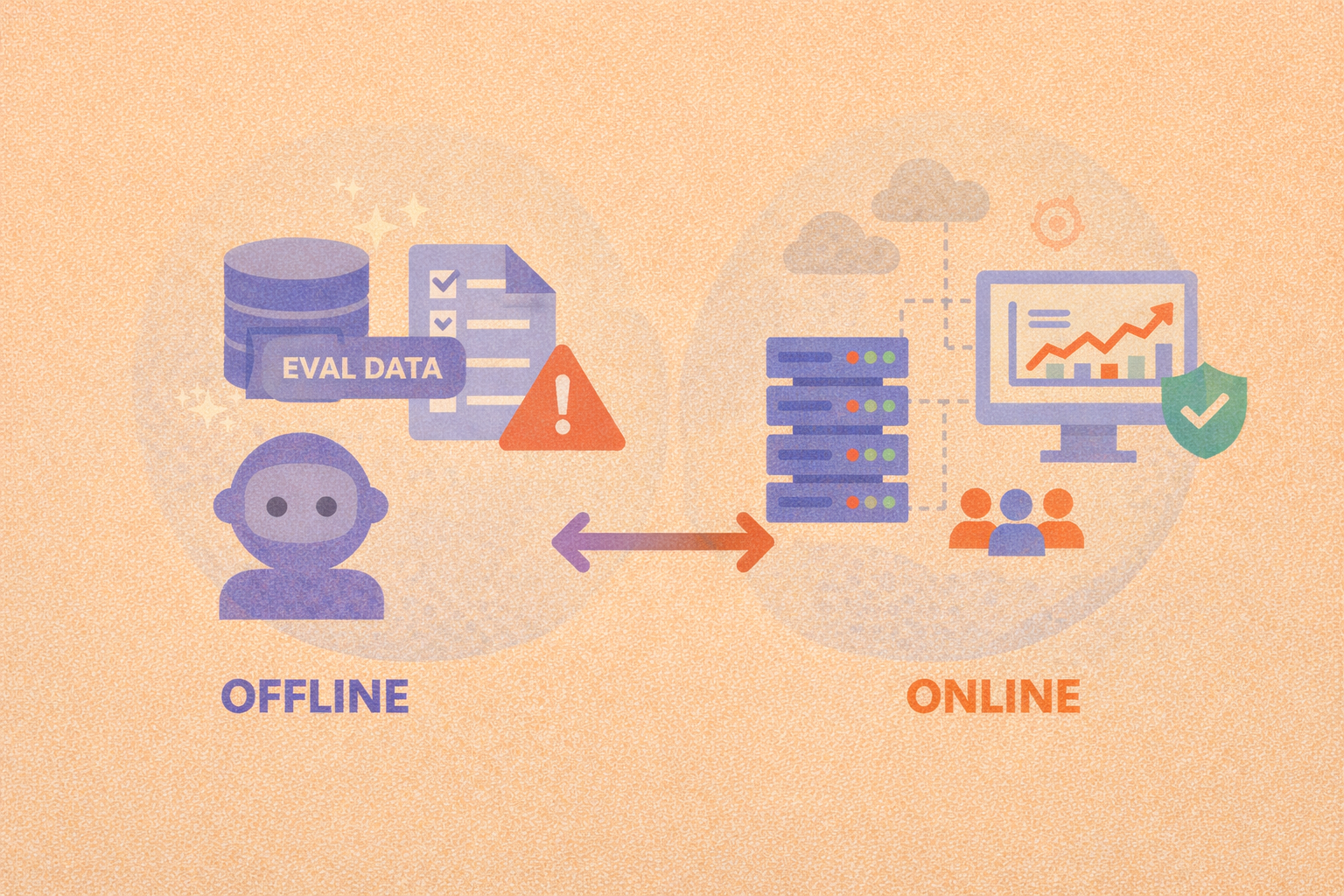
Offline evaluation vs online evaluation: when to use each
Offline evaluation enables fast, repeatable model comparison, while online evaluation confirms whether those gains hold up under real-world conditions.
-
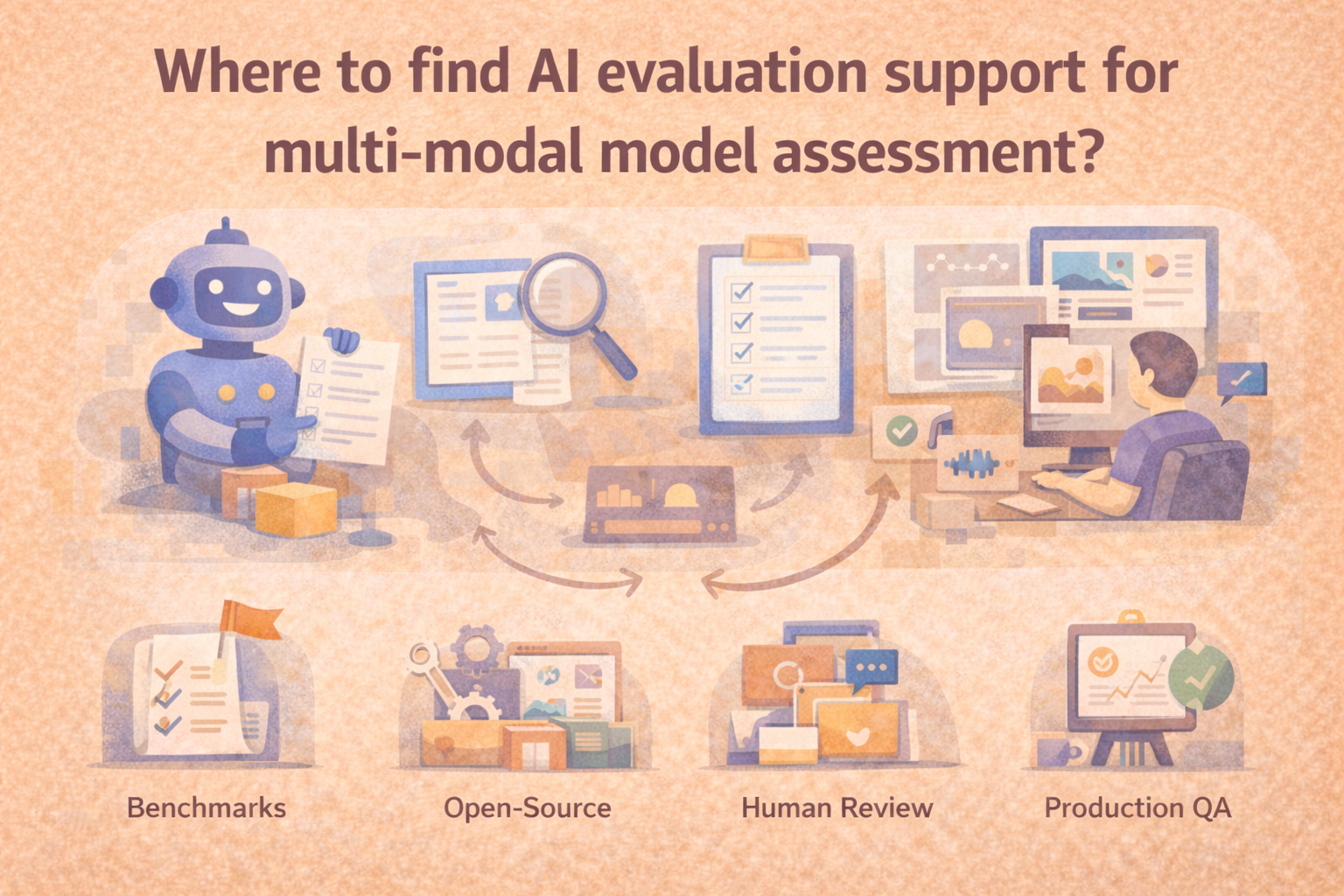
Where to find AI evaluation support for multi-modal model assessment
The right starting point depends on whether you need offline benchmarking, structured human review, regression testing, or real-world monitoring.
-
Human-in-the-Loop Evaluations: Why People Still Matter in AI
Human-in-the-loop (HITL) evaluations bring expert oversight into AI workflows. Learn where humans add value, how to scale review, and when it matters most.
Let me know if you'd like a hero image or a CTA linking this to your evaluations pillar page.
-
How to Automatically Catch Mistakes from Large Language Models
Evaluating the quality of large language model (LLM) outputs isn't one-size-fits-all. This guide breaks down four key methods, reference comparison, LLM-as-a-judge, rule-based checks, and classifiers, to help you automatically detect common errors like hallucinations, bias, and off-topic responses. Learn when and how to apply each method effectively.
-
AI Governance and Compliance: Why Evaluations Are the Missing Link
Without strong evaluation workflows, compliance with ethical and legal standards is impossible to verify, let alone enforce. Here’s how to close the gap.
-
This hub explores the full spectrum of evaluation methods, from metrics to human-in-the-loop reviews and LLM-based scoring across multiple articles.
-

Machine Learning Evaluation Metrics: What Really Matters?
Accuracy isn’t everything. Learn how precision, recall, F1 score, and more help you measure what really matters in machine learning model performance.
-
Understanding Model Accuracy: How to Evaluate Your AI
Accuracy is one of the most common metrics in machine learning evaluation, but it’s also one of the most misunderstood. Here’s how to use it wisely.
-

How to Get Demos of AI Evaluation Software Before You Buy
This guide explains how to prepare the right sample outputs, define structured review criteria, ask the right integration questions, and compare tools clearly before you buy.
-
What does a 90% human preference win rate actually prove?
What a reported preference win rate mechanically is, the four disclosures a headline number omits, and how to report one that survives scrutiny.
-
How to Monitor AI Performance in Production: A Guide to Continuous Evaluation and Drift Detection
AI models don’t stop learning after deployment, but that doesn’t mean their performance stays reliable. This guide covers how to monitor your models in the real world, detect drift, and maintain accuracy over time.
-
Popular AI evaluation APIs for developers
AI evaluation APIs make it easier to run repeatable tests, track results over time, and catch regressions, as long as you design the workflow around versioning, traceability, and meaningful metrics.
-

What AI evaluation platforms specialize in assessing generative AI models?
GenAI evaluation works best when teams can review multi-turn outputs with consistent rubrics, shared workflows, and reliable governance.