The Five Stages to Keeping Benchmarks Useful as Models Evolve

Enterprise AI systems can look strong in demos, then production introduces edge cases, inconsistent behavior, and outputs that are hard to explain. Once teams start iterating quickly with new prompts, model versions, and workflow changes, evaluation becomes the hard part because it is no longer obvious what actually improved and what simply shifted.
Benchmarking gives teams a stable way to measure progress across those changes. It complements targeted evals that check for specific risks or requirements, while benchmarks provide repeatable comparison across a defined set of scenarios.
As systems evolve, benchmarks evolve too. The most useful benchmarks expand over time based on what breaks in the real world, which is why versioning and documentation matter when results need to stay interpretable across releases.
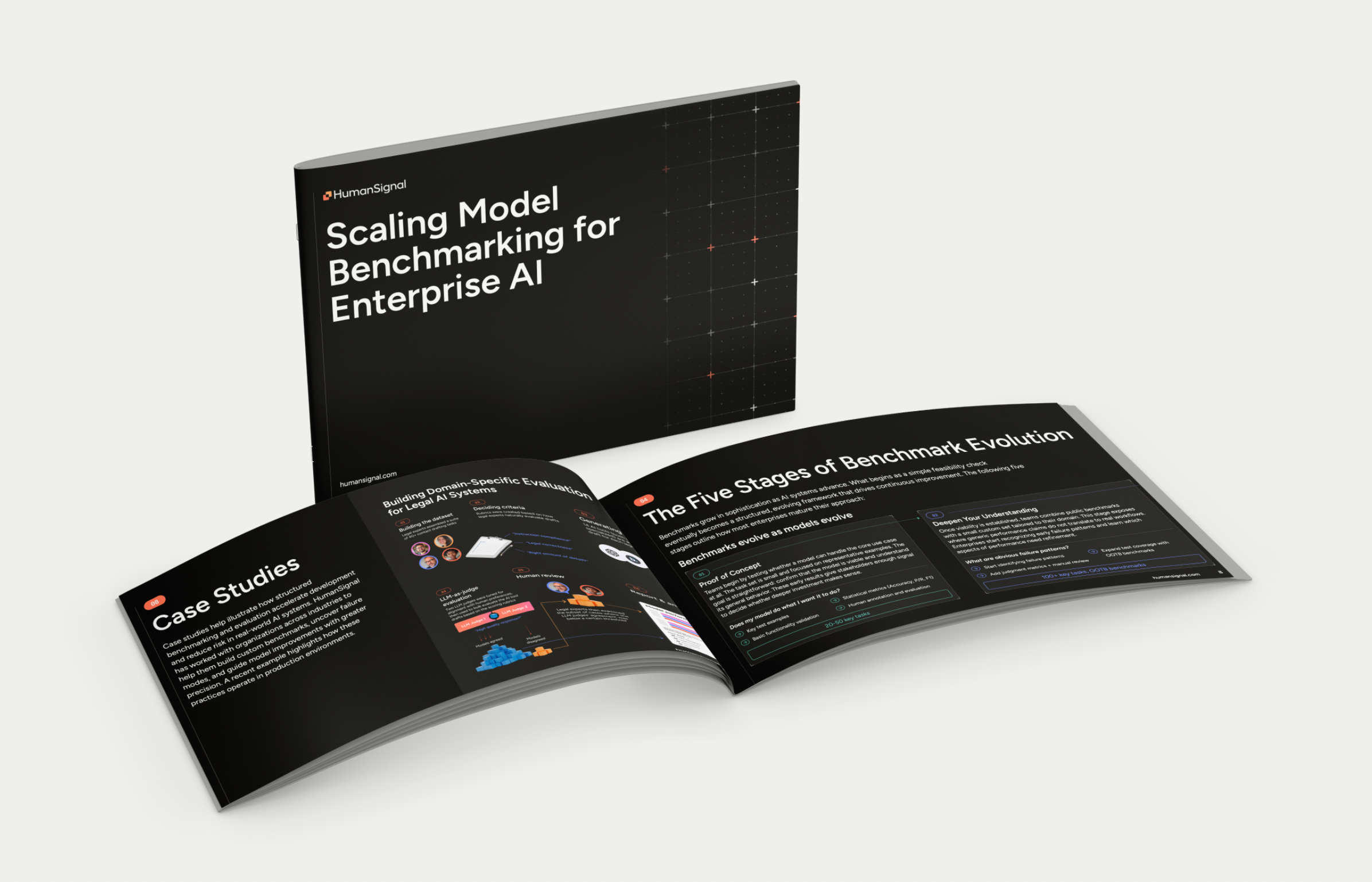
This post lays out a five-stage maturity curve for how benchmark programs evolve, plus what teams build at each stage.
This is an excerpt from our guide “Scaling Model Benchmarking for Enterprise AI.” You can download the complete guide here.
Stage 1: Proof of concept
Stage 1 is about proving the workflow is viable with a small, representative set of examples. Teams use this stage to confirm the system can complete the core job under normal conditions and to surface the most obvious gaps early. The goal is a clear baseline and a quick read on whether the approach is worth deeper investment, not a comprehensive measurement of performance.
What to build
- A small, representative task set (20–50 tasks). Choose examples that mirror the real workflow and the most common user intent, not edge cases. The goal is fast feedback on whether the system can handle the core job.
- A simple scoring approach you can apply consistently. Start with basic pass/fail checks where possible and add human review where judgment is required. Consistency matters more than sophistication at this stage.
- A running list of failure patterns. Track recurring issues in plain language (missing facts, refusal problems, brittle formatting) so the next iteration has a clear target.
Stage 2: Deepen your understanding
Once the system works in principle, teams need to understand where it works well and where it breaks. Stage 2 expands coverage so results can be analyzed by category, domain slice, and failure pattern, rather than relying on a single headline score. This is also where custom tasks start to matter more, because enterprise inputs, terminology, and constraints rarely match generic benchmarks.
What to build
- A broader benchmark (100+ tasks) with tagged coverage. Expand beyond the happy path and label tasks by category so you can see where performance changes, not just whether the average score moves.
- A domain slice that reflects real inputs and constraints. Add tasks that use your terminology, documents, and typical context so results translate into real-world expectations.
- A balanced mix of context and relevance. Keep a small public reference suite for comparison, then rely on custom tasks for decision-making since those match your environment.
A concrete example of custom benchmarking in practice is here: Evaluating the GPT-5 Series on Custom Benchmarks
Stage 3: Customization and domain specialization
Stage 3 turns benchmarking into a tool for diagnosis and prioritization. Teams build domain-specific task sets that reflect real workflows and use more structured evaluation criteria so results connect directly to what needs fixing. This is where rubrics and consistent SME review become important, since quality is multi-dimensional and stakeholders need to understand why an output passed or failed.
What to build
- A rubric that defines quality in your domain. Break “good” into dimensions reviewers can apply repeatedly, such as correctness, completeness, safe handling, and reasoning quality. Include short examples so SMEs interpret criteria the same way.
- A task set built around known pain points. Prioritize scenarios that trigger failures in production, including ambiguous requests and cases where policy or business rules matter. This turns the benchmark into a diagnostic tool, not just a score.
- A review workflow that enforces consistency across SMEs. Standardize reviewer instructions and add lightweight checks (spot review or consensus on a subset) so results do not drift as more reviewers participate.
Stage 4: Production performance
By Stage 4, the benchmark supports release decisions. Coverage expands to include the messy cases that show up in production, including ambiguous requests, incomplete context, policy constraints, and scenarios where small upstream changes cause downstream failures. Teams use this stage to compare versions reliably, catch regressions early, and report results in a way that product and risk stakeholders can use.
What to build
- Versioned benchmark datasets tied to releases. Treat the benchmark like a release artifact so you can reproduce results later and explain why a decision was made.
- Reporting that highlights tradeoffs and failure modes. Break results down by category and risk so you can answer questions like “what got better, what got worse, and where is the risk concentrated.”
- Regression detection that runs as part of readiness. Add a repeatable check that flags meaningful backslides before deployment, especially for high-impact scenarios and guardrail requirements.
- A clear split between benchmarks and targeted evals. Use benchmarks for consistent comparison across versions, and use targeted evals for ongoing checks on specific constraints such as policy compliance, formatting requirements, or safety.
Stage 5: Continuous evolution
Stage 5 is where benchmarking becomes a sustained practice instead of a periodic exercise. Teams evolve the task set based on real failures, refine rubrics as expectations become clearer, and introduce calibrated automation to keep up with evaluation volume. Versioning becomes the backbone of the program, so results remain interpretable across time even as the benchmark expands.
What to build
- A stable calibration set scored by humans. Maintain a trusted reference set that anchors scoring over time, especially when reviewers change or you introduce automated scoring.
- Disagreement routing that strengthens the standard. Send low-confidence or high-risk cases back to experts, then use those outcomes to refine the rubric and add new benchmark tasks. This keeps the benchmark aligned to reality as behavior evolves.
- A versioning and change-log practice for every benchmark update. Record what changed, why it changed, and how it affects comparability so teams can interpret trends across time without confusion.
- Calibrated automation where it helps throughput. Introduce automated scoring only when it has been checked against human judgment and has clear rules for escalation, so scale increases without undermining trust.
For a deeper look at benchmark evolution as a practice, read: How to Build AI Benchmarks that Evolve with your Models
When benchmarks power iteration
Benchmark programs mature in a predictable way. Teams begin with a feasibility suite, expand coverage to understand failure patterns, move into domain-specific diagnostics, use benchmarks as part of release readiness, and then sustain improvement through versioning and iteration. Across every stage, the benchmark functions as a living artifact. As teams refine tasks, strengthen evaluation criteria, and introduce automation, benchmark versions and result history become a dependable mechanism for understanding and improving AI performance.
If you are building toward that kind of evaluation program and want help designing a benchmark strategy or scaling the workflow around it, we can help.
Related Content
-

How Yext Built an AI-in-the-Loop Benchmark with Label Studio Enterprise
Learn how Yext used Label Studio Enterprise to benchmark LLMs against human annotators, build trusted ground truth datasets, and analyze results to improve AI-in-the-loop workflows.

Sheree Zhang
August 6, 2026
-

Building a Quality Estimation Benchmark: The impact of relying on AI judges
What happens when you let AI judge AI? A pioneer benchmark for quality estimation in machine translation.
Sheree Zhang
December 22, 2025
-

Evaluating the GPT-5 Series on Custom Benchmarks
GPT-5 is out now -- but how good is it, really? In this post, we'll show you how we created our own custom Benchmark to evaluate GPT-5.
Sheree Zhang
August 8, 2025