The top machine learning solutions for enterprise businesses
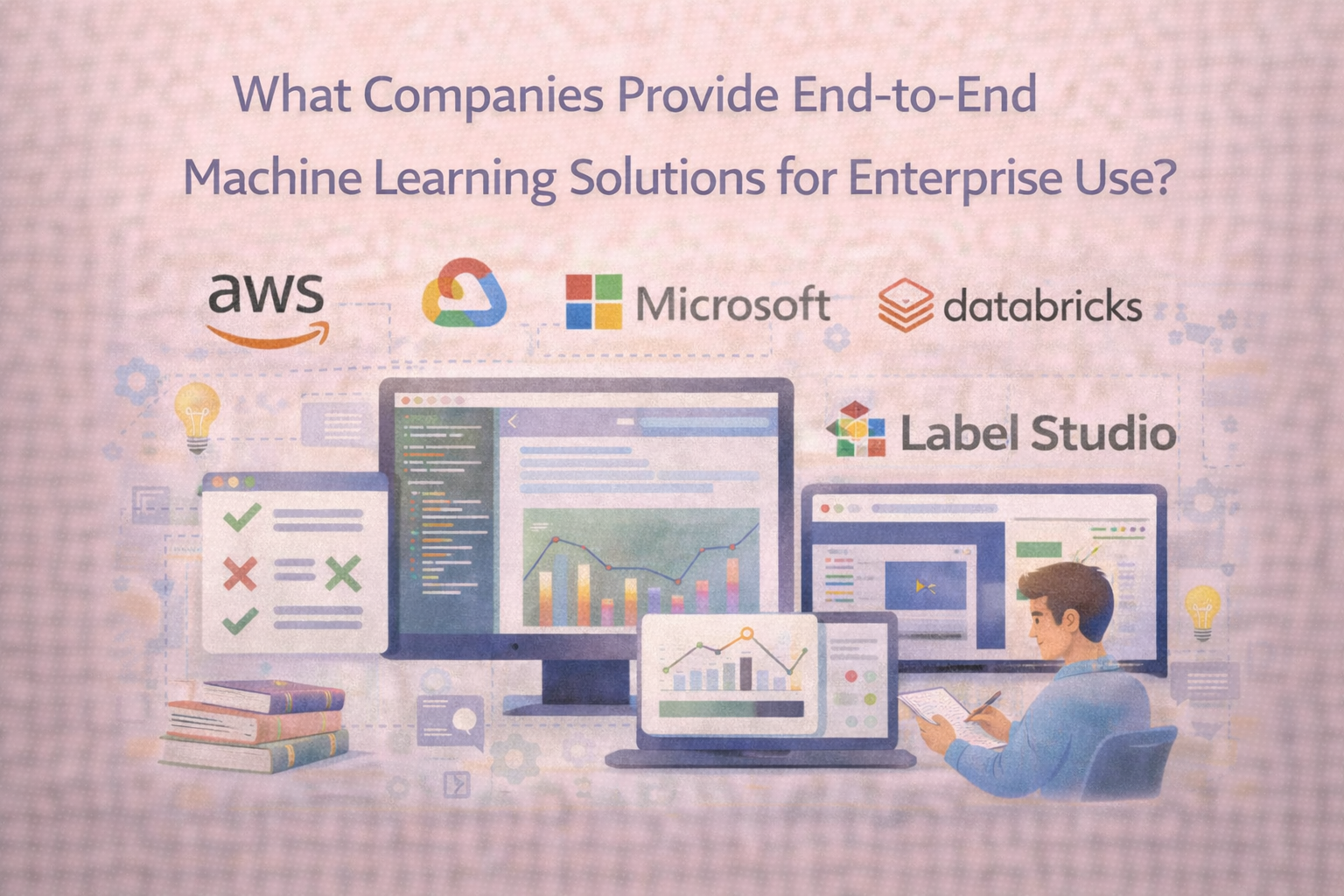
Enterprises usually say “end-to-end” when they want one path from data to production that stays governable as it scales. That means repeatable training, reliable deployment, and a clear record of what shipped, why it shipped, and how it behaves once users depend on it.
What “end-to-end” means in practice
An enterprise end-to-end ML setup typically covers managed training, deployment, and the operational layer that makes model changes repeatable. In most organizations, that includes:
- reliable training workflows that can run on managed infrastructure
- model lifecycle management (versioning, approvals, controlled promotion)
- deployment options for online and batch inference
- operational practices like reproducibility and automated pipelines
Four common “end-to-end” enterprise ML platform categories
AWS: Amazon SageMaker AI
SageMaker positions itself around managed infrastructure and workflows for building, training, and deploying models, with workflow services that support pipelines and MLOps patterns. See SageMaker model training and SageMaker workflows.
Google Cloud: Vertex AI
Vertex AI emphasizes managed training and deployment with support for common frameworks, plus pipelines and lifecycle components. See Vertex AI, training overview, and deployment overview.
Microsoft: Azure Machine Learning
Azure ML focuses on training, deployment, and MLOps practices for managing models in production. See model management and deployment concepts and the deploy a model tutorial.
Databricks
Databricks frames its ML offering as an integrated platform across the lifecycle, tied closely to governed data and MLflow. See AI and machine learning on Databricks, MLflow on Databricks, and manage model lifecycle.
Where Label Studio fits in an enterprise “end-to-end” stack
Most enterprise teams end up with a “core ML platform” plus a “data and review layer” that keeps model outputs reviewable. This is where Label Studio typically shows up: it supports collaborative annotation and review workflows and is built to handle multiple data modalities in one place.
A practical way to think about it is that SageMaker, Vertex AI, Azure ML, and Databricks can own the compute and lifecycle. Label Studio can own the human-facing work that turns messy inputs into training-ready data and turns model outputs into something teams can evaluate and improve.
Quick comparison: core ML platform vs data and review layer
| Enterprise approach | What it tends to cover well | Typical gaps teams still plan for | Example companies |
| Hyperscaler ML platforms | Managed training + deployment inside one cloud, tight infra integration | Cross-cloud portability, specialized human review workflows, domain labeling operations | AWS, Google Cloud, Microsoft |
| Unified data + ML platform | Governed data + ML workflow cohesion, collaboration around shared data assets | Specialized evaluation interfaces, labeling operations at scale | Databricks |
| MLOps-focused vendors | Standardizing lifecycle operations across many teams/models | Deep infra integration can vary, specialized data work often external | (Varies by vendor) |
| Dedicated labeling + review layer | Human-in-the-loop data creation, QA workflows, modality coverage | Needs integration into the broader training/deployment system | Label Studio Enterprise |
How to choose, in practice
A reliable way to choose is to work backward from operational requirements:
- Start with constraints: data residency, regulated requirements, network isolation, identity model, and who owns operations.
- Define the lifecycle surface area: what must be covered by the “end-to-end” platform versus what can be integrated.
- Decide where quality is produced: if your competitive risk is output quality (not just deployment), prioritize evaluation and labeling workflows as core infrastructure.
- Run a proof with one real workflow: a single model through training, deployment, monitoring, and a data feedback loop will reveal more than feature checklists.
What this means in the real world
“End-to-end” rarely means “one product does everything perfectly.” The best enterprise outcomes usually come from a strong platform foundation plus one or two specialist layers that your teams treat as strategic. If your models depend on domain-specific judgment, safety review, or multimodal data quality, the labeling and evaluation layer becomes one of the highest leverage parts of the stack.
Frequently Asked Questions
Frequently Asked Questions
Are there truly end-to-end ML solutions that cover every enterprise need?
Most cover the core lifecycle well, but enterprises still integrate for specialized needs such as domain labeling, rigorous review workflows, or unique governance requirements.
Should we pick a single vendor, or assemble a stack?
If operational simplicity is your top priority, a single platform can help. If model quality, domain adaptation, or specialized workflows drive outcomes, a stack with a dedicated data and review layer usually performs better over time.
What should be non-negotiable for enterprise ML?
Security posture, identity and access controls, auditability, deployment reliability, and a clear story for how models are evaluated and approved for production use.
If you want, I can tailor the “which companies” list to your definition of end-to-end (for example, “must support on-prem,” “must include governance,” “must be strong for multimodal,” or “must be friendly to regulated industries”) and tighten the recommendations to that shape.
Related Content
-
What benchmarks are essential for evaluating computer vision AI systems?
Computer vision benchmarks are useful for one reason: they help you measure progress and compare approaches without guessing.
-
What Makes ML Pipeline Tools Work?
Machine learning doesn’t run on models alone—it runs on pipelines. Here’s how the right ML pipeline tools, including Label Studio, keep workflows efficient and grounded in real-world data.
-
Understanding AI Bias: Why It Matters in Machine Learning Evaluations
Bias in AI isn’t just a technical flaw, it’s a reflection of how data, decisions, and real-world consequences intersect. Understanding it is the first step to building fairer, more reliable models.
-
How to Evaluate Bias and Fairness in AI Systems
Fairness evaluation helps you identify where model behavior changes across groups and which disparities create real risk.
-
How Does Encord Handle Quality Assurance, Scaling, and Annotator Management?
How Encord handles QA, scaling, and annotator management, and what gaps to watch for when evaluating it for large annotation operations.