How to Evaluate Bias and Fairness in AI Systems
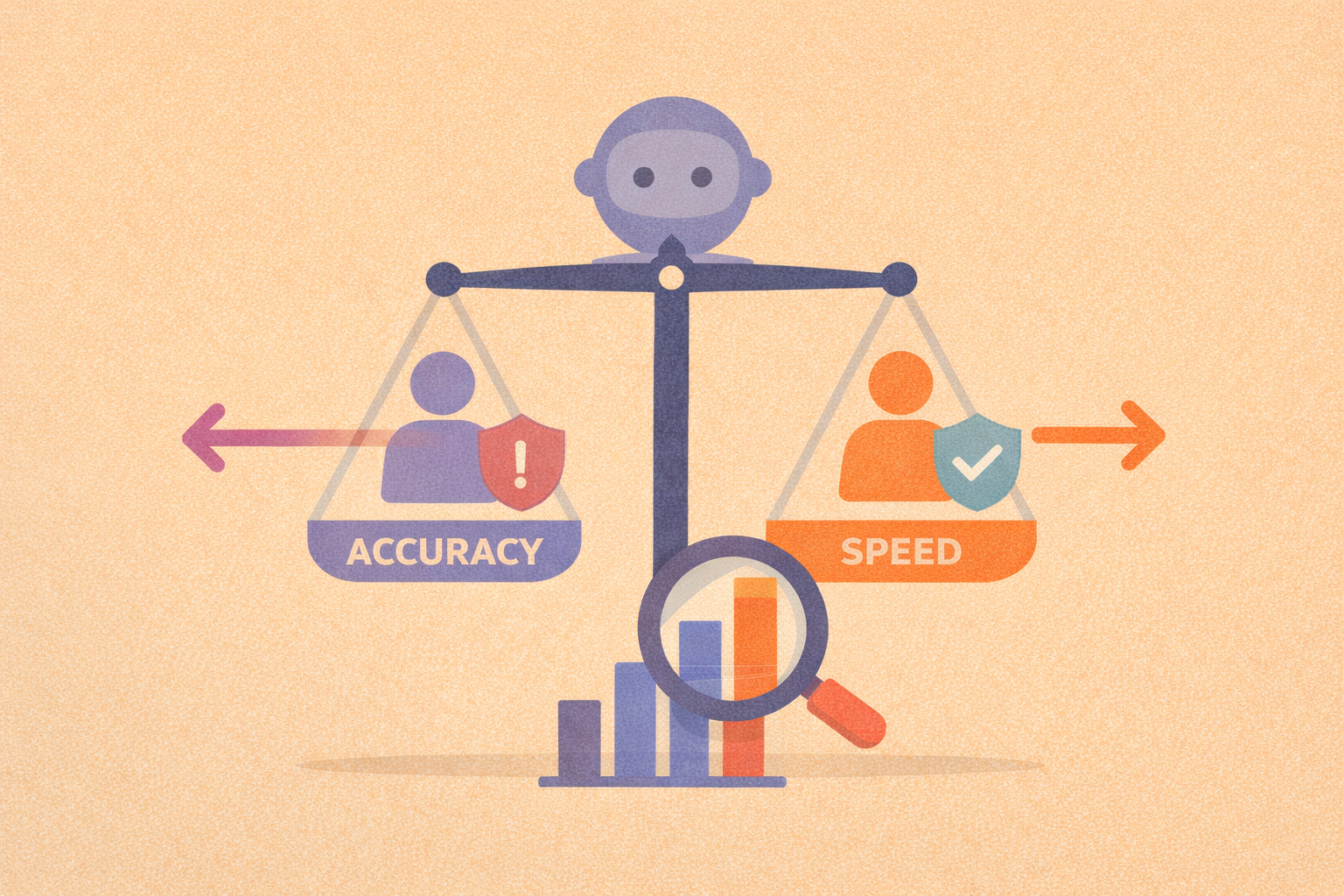
Evaluating bias and fairness in AI systems involves measuring whether model performance or behavior differs across groups, identities, or contexts. Rather than producing a single “fairness score,” effective fairness evaluation helps teams surface risks, understand tradeoffs, and decide where intervention is needed.
Why bias and fairness evaluation matters
Bias and fairness evaluation starts with an important realization: models do not fail uniformly. A system may perform well on average while producing worse outcomes for certain groups or situations. When teams rely only on aggregate metrics, these disparities can remain hidden.
Fairness evaluation exists to make uneven behavior visible. In many applications—such as content moderation, hiring, lending, healthcare, or customer support—uneven errors can cause real harm. Evaluating fairness helps teams identify where a system may be amplifying existing inequalities or introducing new risks.
Crucially, fairness is not a purely technical property. It reflects values, priorities, and tradeoffs that depend on the domain and the people affected. Evaluation is about understanding those tradeoffs, not declaring a system universally fair.
Slice-based evaluation and subgroup analysis
One of the most common techniques for evaluating fairness is slice-based evaluation. Instead of reporting a single performance number, metrics are broken down by subgroup, context, or scenario.
For example, teams might examine performance across different language varieties, user segments, content categories, or demographic proxies. This approach often reveals gaps that disappear when results are averaged together. A model may appear accurate overall but struggle significantly in specific slices that matter operationally or ethically.
The choice of slices is critical. There is no universal set. Slices should be selected based on domain risk, regulatory concerns, and real-world usage patterns. Poorly chosen slices can either miss important disparities or create misleading conclusions.
Slice-based evaluation is most effective when used consistently over time, allowing teams to track whether gaps are shrinking, growing, or shifting as models change.
Counterfactual testing and sensitivity analysis
Another important method for fairness evaluation is counterfactual testing. In these tests, one attribute of an input is changed while the rest remains constant. If the model’s output changes significantly, that can indicate bias or inconsistent behavior.
For language models, this might involve swapping names, pronouns, or identity-related terms. For other systems, it might involve altering contextual signals while preserving task-relevant information. The goal is to test whether the model relies on attributes that should not affect the outcome.
Counterfactual tests are especially useful for uncovering subtle behaviors that do not show up in aggregate metrics. They help teams understand why a model behaves differently, not just that it does.
However, counterfactual testing requires careful design. Attributes are often interdependent, and naive substitutions can introduce unrealistic inputs. Results should be interpreted as signals, not definitive proof.
Evaluating error types, not just error rates
Fairness evaluation is not only about how often a model is wrong, but how it is wrong.
In many domains, different types of errors carry very different consequences. A false positive may be inconvenient in one setting but harmful in another. A false negative may deny access to a service or delay critical action.
Effective fairness evaluation looks at error distributions by group, not just overall accuracy differences. Understanding which errors increase, and for whom, is often more important than small changes in average performance.
This perspective shifts evaluation from “Which group performs worse?” to “Which groups experience the most harmful failures?”—a framing that is more actionable and aligned with real-world risk management.
Limitations of fairness evaluation
No fairness evaluation is complete or final. Benchmarks and datasets cannot capture every real-world context, and many sensitive attributes are represented indirectly or imperfectly. Some harms only emerge after deployment, when systems interact with real users in unpredictable ways.
Fairness metrics can also conflict with one another. Improving one measure may worsen another. These tradeoffs cannot be resolved by metrics alone and require human judgment and organizational decision-making.
For these reasons, fairness evaluation should be treated as an ongoing process, not a certification step. Results should inform iteration, monitoring, and governance rather than serve as a one-time approval.
Frequently Asked Questions
Frequently Asked Questions
Is there a single fairness metric?
No. Fairness depends on context, values, and the types of harm that matter in a given domain.
Can fairness evaluation be fully automated?
No. Metrics and tests provide signals, but human judgment is essential for interpreting results and deciding tradeoffs.
When should fairness be evaluated?
Throughout development and after deployment, especially when data, usage patterns, or policies change.
Related Content
-
What benchmarks are essential for evaluating computer vision AI systems?
Computer vision benchmarks are useful for one reason: they help you measure progress and compare approaches without guessing.
-
What Makes ML Pipeline Tools Work?
Machine learning doesn’t run on models alone—it runs on pipelines. Here’s how the right ML pipeline tools, including Label Studio, keep workflows efficient and grounded in real-world data.
-
Understanding AI Bias: Why It Matters in Machine Learning Evaluations
Bias in AI isn’t just a technical flaw, it’s a reflection of how data, decisions, and real-world consequences intersect. Understanding it is the first step to building fairer, more reliable models.
-
The top machine learning solutions for enterprise businesses
A clear map of the major enterprise ML “end-to-end” providers, plus the missing pieces most teams still need to operationalize models.
-
How Does Encord Handle Quality Assurance, Scaling, and Annotator Management?
How Encord handles QA, scaling, and annotator management, and what gaps to watch for when evaluating it for large annotation operations.