What benchmarks are essential for evaluating computer vision AI systems?
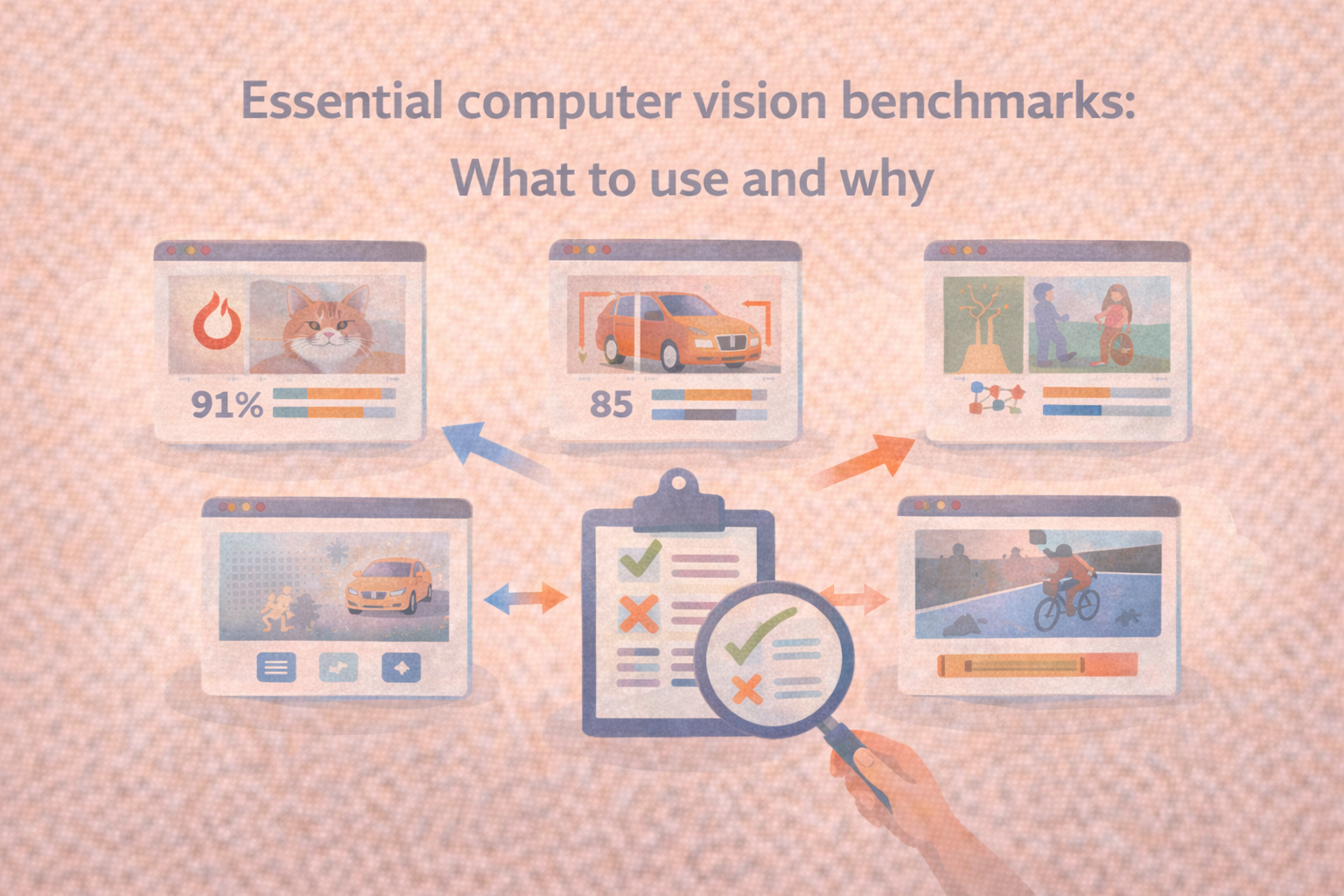
Computer vision benchmarks are useful for one reason: they help you measure progress and compare approaches without guessing. The catch is that “computer vision” includes very different tasks, and each task has different failure modes. A benchmark that is excellent for classification can tell you very little about detection, and a benchmark that looks strong in the lab can still miss what breaks in production.
A reliable approach is to treat benchmarks as a layered system. Start with a widely used reference benchmark for your task so results are comparable, then add a second benchmark that stresses the model in ways your real environment will.
The benchmark families most teams start with
Image classification
For classification systems, benchmarks like ImageNet are often used as a baseline because they help teams compare model families and training recipes using a common reference point. Smaller datasets like CIFAR-10/100 are still useful when you need fast iteration and quick sanity checks. These benchmarks are “essential” when your system outputs labels and you need a consistent baseline, but they should not be the only evidence you rely on when your production data has a different look and feel.
Object detection
Detection systems need benchmarks that test localization and precision/recall tradeoffs, not just whether the right class name appears somewhere in an image. COCO remains one of the most common reference points because it captures a broad set of everyday objects and supports modern detection metrics. Pascal VOC is older, but still helpful for simpler detection setups and historical comparisons. If you need large-scale category coverage, Open Images is another widely cited dataset.
Segmentation
Segmentation benchmarks become essential when pixel-level or region-level correctness affects downstream behavior. For street-scene segmentation, Cityscapes is a common reference point. For broader scene parsing, ADE20K is frequently used. COCO also supports segmentation tasks via its dataset and annotations, so many teams use COCO for instance segmentation comparisons as well.
3D perception and autonomous systems
If your model relies on depth, point clouds, or multi-sensor input, 2D benchmarks are rarely enough. Benchmarks like KITTI helped define early evaluation patterns for driving perception, while more modern multi-sensor datasets such as nuScenes and the Waymo Open Dataset are often used to evaluate detection, tracking, and scene understanding under real driving conditions.
Video understanding
For systems that interpret motion or events over time, video benchmarks matter because single-frame evaluation misses temporal consistency. Kinetics is a common baseline for action recognition, and Something-Something is often used when you want to test whether models can reason about subtle action differences and context across frames.
Comparison: choosing benchmarks that actually predict production performance
A practical comparison strategy is to pick benchmarks that serve different roles, rather than searching for one dataset that claims to cover everything.
You typically want:
- one benchmark that is widely recognized for your task type, so results are comparable
- one benchmark that reflects your domain or deployment conditions, so results remain relevant
- one benchmark or test set that stresses robustness, so you can see what breaks under shift
Comparison table: which benchmarks are “essential” for which vision tasks
| Task type | Common benchmark starting point | What it tells you | What it may miss |
| Classification | ImageNet | Baseline recognition performance and generalization | Real-world domain shift and edge cases |
| Detection | COCO | Localization quality and precision/recall tradeoffs | Small-object or long-tail domain specifics |
| Segmentation | Cityscapes / ADE20K | Pixel-level boundaries, instance separation, scene parsing | Different camera environments and labeling conventions |
| 3D perception | nuScenes / Waymo Open Dataset | Multi-sensor perception, tracking, scene context | Non-driving domains or unique sensor setups |
| Video understanding | Kinetics | Action recognition and temporal signals | Long-horizon workflows or rare events |
Benchmarks that improve reliability, not just leaderboards
Robustness and distribution shift
Standard benchmarks often reward learning shortcuts that do not hold up in messy environments. Robustness benchmarks help you understand whether performance collapses when images are corrupted, viewpoints shift, or styles change. Datasets like ImageNet-C and ObjectNet are commonly referenced for this reason. Even if you do not use them as your primary metric, they are useful as “stress tests” that catch regressions earlier.
Domain-specific evaluation
If you work in medical imaging, manufacturing, retail, geospatial, or any specialized context, your essential benchmark is often an internal, versioned test set that reflects your real environment. Public benchmarks still matter because they give you a shared baseline, but internal evaluation is what determines whether the system is fit for your use case.
Diagnostics that make benchmark scores actionable
Benchmark scores become more useful when they help teams understand failure patterns. Per-class metrics, slice-based analysis (for example by device type or lighting), and calibration checks often point to the next engineering step faster than adding another dataset. These diagnostics are also how teams avoid being misled by averages that hide minority class failures.
Frequently Asked Questions
Frequently Asked Questions
What are the most essential vision benchmarks for most teams?
Teams usually start with a standard benchmark for their task, then add one robustness benchmark and one domain-representative evaluation set. That combination balances comparability with realism.
Are public benchmarks enough to decide if a model is production-ready?
Usually not. Public benchmarks are great for baseline comparison, but production readiness depends on how closely your evaluation data matches your environment, cameras, and label definitions.
How many benchmarks should be used before shipping a model?
A small set is often better than a long list. One primary benchmark plus a robustness test and a domain-aligned test set typically provides stronger coverage than many loosely related datasets.
Why do models look strong on benchmarks but fail in the real world?
Benchmarks can saturate, data distributions can shift, and models can learn shortcuts that do not transfer. Robustness tests and domain-specific evaluation reduce this risk.
Related Content
-
What Makes ML Pipeline Tools Work?
Machine learning doesn’t run on models alone—it runs on pipelines. Here’s how the right ML pipeline tools, including Label Studio, keep workflows efficient and grounded in real-world data.
-
Understanding AI Bias: Why It Matters in Machine Learning Evaluations
Bias in AI isn’t just a technical flaw, it’s a reflection of how data, decisions, and real-world consequences intersect. Understanding it is the first step to building fairer, more reliable models.
-
How to Evaluate Bias and Fairness in AI Systems
Fairness evaluation helps you identify where model behavior changes across groups and which disparities create real risk.
-

The top machine learning solutions for enterprise businesses
A clear map of the major enterprise ML “end-to-end” providers, plus the missing pieces most teams still need to operationalize models.
-
How Does Encord Handle Quality Assurance, Scaling, and Annotator Management?
How Encord handles QA, scaling, and annotator management, and what gaps to watch for when evaluating it for large annotation operations.