What are the best machine learning frameworks for natural language processing?
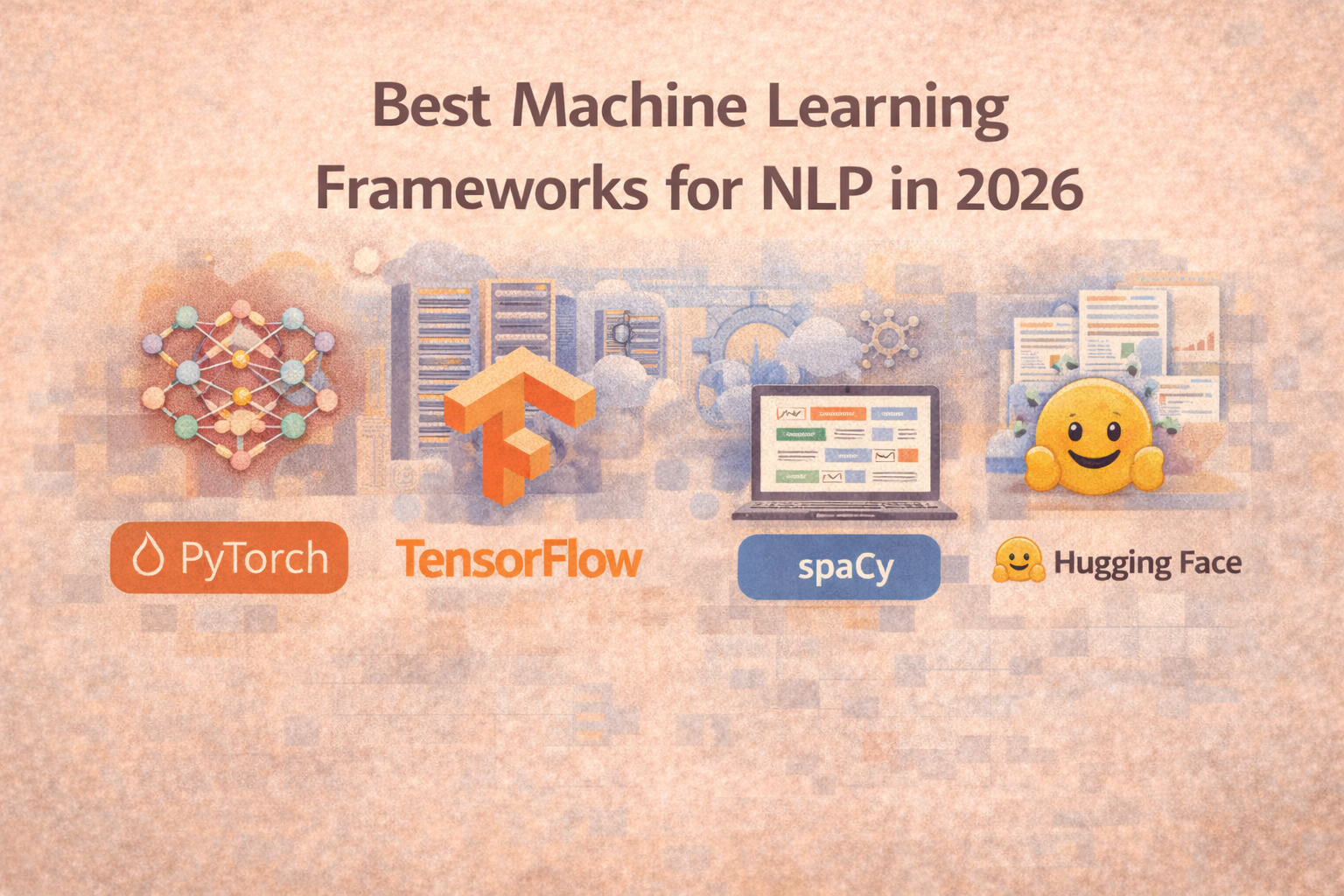
The “best” machine learning framework for NLP depends on what you’re building. Training large transformer models, fine-tuning a domain model, serving low-latency inference, or shipping a pipeline for extraction and classification all favor different strengths.
Below are the frameworks most commonly used for NLP today, what they’re good at, and how to choose based on your workflow.
1) PyTorch
PyTorch is the default choice for a large share of modern NLP research and production model development, especially for transformer training and fine-tuning. It’s widely used across open-source model ecosystems, integrates cleanly with popular tooling, and makes it straightforward to iterate quickly on model architecture and training loops.
PyTorch is a strong fit if you:
- Fine-tune or train transformer models
- Want a flexible, developer-friendly training experience
- Rely on a broad ecosystem of pretrained models and training utilities
2) TensorFlow (and Keras)
TensorFlow remains a major framework for teams that prioritize stable production deployment paths, especially when they already have TensorFlow infrastructure and MLOps patterns in place. Keras provides a higher-level API that can speed up development and keep training code consistent across projects.
TensorFlow is a strong fit if you:
- Already deploy with TensorFlow Serving or TF-based infrastructure
- Want a well-established production deployment pathway
- Prefer Keras-style model development and training workflows
3) JAX
JAX is popular for high-performance training, particularly for teams doing research-heavy work, experimenting with new training approaches, or scaling training across accelerators efficiently. It’s often used when performance and composability are priorities and the team is comfortable with a more “systems-y” development style.
JAX is a strong fit if you:
- Need high-performance training at scale
- Want fine-grained control over computation and optimization
- Have a team that’s comfortable with more low-level training workflows
4) spaCy
spaCy is less about training large transformer models from scratch and more about building robust, production-friendly NLP pipelines. It’s commonly used for tasks like named entity recognition, tokenization, text classification, and information extraction—especially when teams want something practical, fast, and maintainable.
spaCy is a strong fit if you:
- Need reliable NLP pipelines (NER, classification, extraction)
- Prioritize speed, maintainability, and production ergonomics
- Want to combine rule-based components with ML models
5) Hugging Face ecosystem (Transformers + Datasets + Evaluate)
Hugging Face isn’t a single “framework,” but it acts like one for many NLP teams because it standardizes the workflow around pretrained models, tokenizers, training utilities, and evaluation tooling. Most teams use it on top of PyTorch (or sometimes TensorFlow), which makes it a practical default for fine-tuning modern NLP models.
Hugging Face is a strong fit if you:
- Fine-tune pretrained transformer models
- Want fast iteration using a standardized training stack
- Need access to a broad model ecosystem and evaluation helpers
How to choose the right framework for your NLP work
If you’re training or fine-tuning transformers, PyTorch is the most common default, often paired with Hugging Face tooling. If you’re building production pipelines for extraction, NER, or classification, spaCy is a practical choice. If you’re scaling training and optimizing performance heavily, JAX can be the right fit. If your organization is already built around TensorFlow for deployment, TensorFlow/Keras can reduce friction.
A simple way to choose is to match the framework to the bottleneck:
- If your bottleneck is research iteration, choose the most flexible stack your team moves fastest in.
- If your bottleneck is production deployment, choose the stack that fits existing infra.
- If your bottleneck is training scale and efficiency, choose the stack designed for high-performance workloads.
If your bottleneck is pipeline reliability, choose tooling optimized for practical NLP workflows.
Frequently Asked Questions
Frequently Asked Questions
Which framework is best for transformer fine-tuning?
Most teams fine-tune transformers using PyTorch with the Hugging Face Transformers ecosystem because it provides pretrained models, tokenizers, and training utilities that speed up iteration.
Is TensorFlow still used for NLP?
Yes. TensorFlow is common in organizations that already deploy TensorFlow models in production or prefer Keras-based workflows. It can be a strong choice when it fits your existing infrastructure.
When should I consider JAX for NLP?
JAX is worth considering when training performance and scaling across accelerators are key requirements, and your team is comfortable working closer to the underlying computation and optimization model.
Is spaCy a machine learning framework?
spaCy is better described as a production-focused NLP library and pipeline framework. It’s widely used for NER, text classification, and information extraction, often alongside deep learning frameworks for training.
Related Content
-
What machine learning tools support automated deployment to Kubernetes clusters?
Automated ML deployment to Kubernetes typically combines a Kubernetes-native serving layer (KServe, Seldon, or BentoML+Yatai) with pipeline orchestration and GitOps delivery (Kubeflow, Helm, Argo CD).
-

Where can I find machine learning courses offered by leading tech companies?
Start with structured ML courses from major tech providers, then reinforce the concepts with hands-on videos that walk through real data, labeling, and model iteration.