Where can I find machine learning courses offered by leading tech companies?
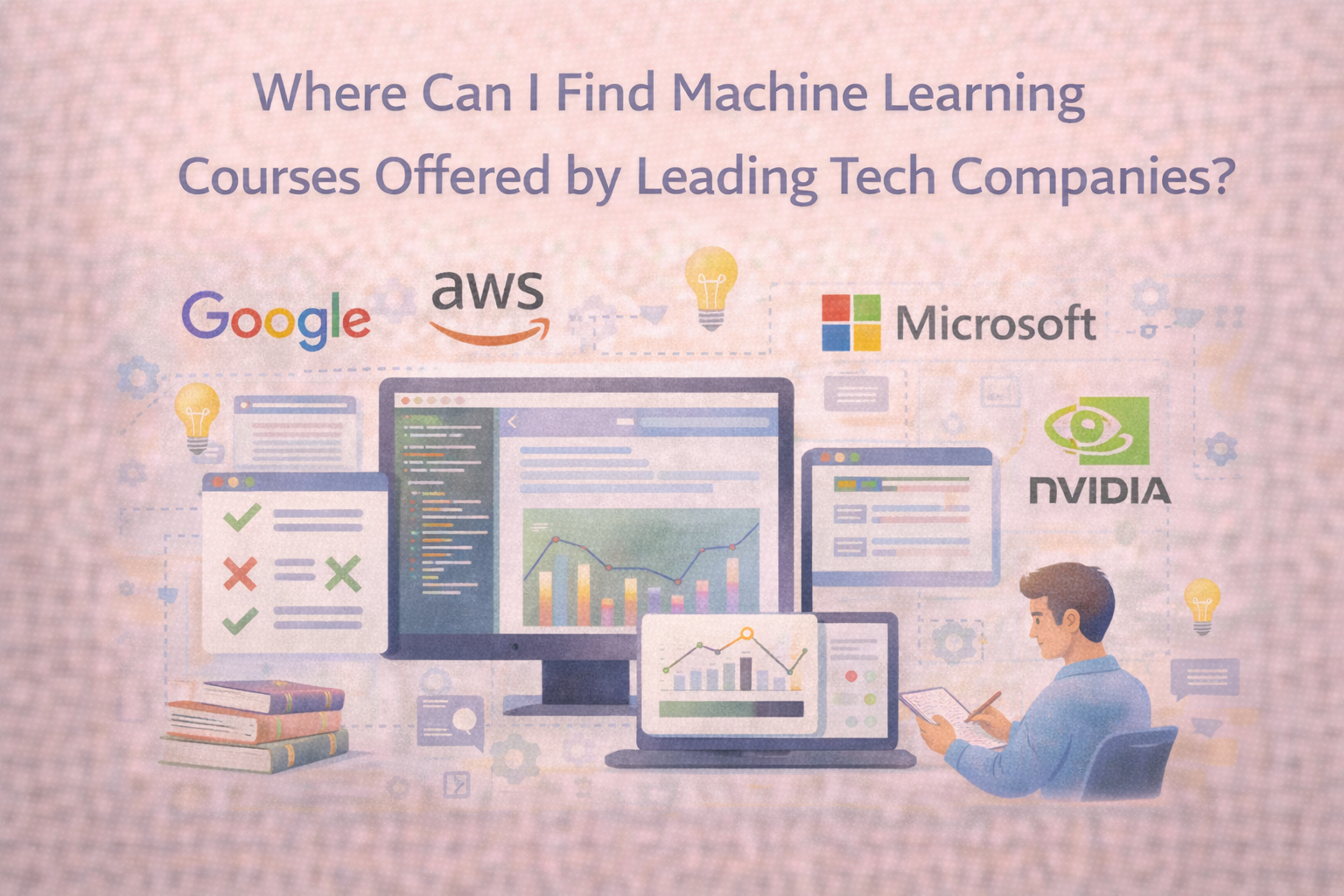
If you’re searching for machine learning courses from leading tech companies, you’ll usually run into two different kinds of learning. The first is structured coursework: fundamentals, common ML patterns, and the building blocks that show up in most teams’ stacks. The second is applied training: the practical workflows that turn “I understand the concept” into “I can ship this on real data.”
The fastest path tends to combine both. Use big-company courses for the foundation, then reinforce that learning with hands-on tutorials that mirror how ML projects actually run: collecting data, labeling, evaluating quality, and iterating.
Courses from leading tech companies
Google: strong fundamentals and clear learning paths
Google has two reliable starting points depending on what you need. If you want a quick, concept-first ramp, the Machine Learning Crash Course is a classic because it stays focused on core ideas and includes interactive pieces that help the material stick.
If your goal is a more structured path that aligns with production workflows, Google’s Cloud Skills Boost learning paths for machine learning give you a guided sequence that looks more like real work. It’s a useful option when you want to learn in small chunks and still feel like you’re building toward a complete capability set.
- Google Machine Learning Crash Course
- Google Cloud Skills Boost learning paths
- Google Cloud ML & AI training hub
AWS: practical, role-based training that maps to real projects
AWS training tends to work well if you like role-based structure and want your learning to align with what teams actually do in production. AWS Skill Builder learning plans are designed around progression, and they often pair conceptual modules with practical exercises and labs. It’s a good fit when your goal is job-ready fluency rather than purely academic depth.
Microsoft: modular learning that works well for steady progress
Microsoft Learn is a strong option when you want shorter modules that build momentum. The format is approachable, especially if you’re learning alongside work, and it’s easy to stitch modules into a personal plan based on what you’re trying to build next. If you like step-by-step guidance and clear checkpoints, this ecosystem is worth leaning on.
NVIDIA: hands-on deep learning training with a compute focus
If you’re working with deep learning and you want training that takes GPU considerations seriously, NVIDIA’s Deep Learning Institute content is often the most direct route. It’s especially helpful when you want to understand why certain workloads behave the way they do and how performance choices show up in practice.
The missing piece in most “courses”: applied workflow practice
Even great courses can leave a gap: you understand training and evaluation in theory, but you still need practice with the parts that slow teams down in real projects. That usually includes:
- Getting data into a usable format
- Creating consistent labeling guidelines
- Running model-assisted labeling to move faster
- Reviewing edge cases and improving quality over time
- Turning annotations into training-ready datasets
That’s where a hands-on video track helps, especially when the content is organized around real tasks rather than general concepts.
A hands-on video track you can follow alongside courses
The Label Studio video library works well as a practical companion because it focuses on workflows you can replicate quickly. If you want a simple learning plan, you can treat the videos below as a mini-curriculum that connects the ideas you learn from Google, AWS, Microsoft, or NVIDIA to the day-to-day work of building datasets and improving model performance.
Step 1: Get oriented and set up a real project
Start by getting comfortable with the basics and running your first project end-to-end. This makes everything else easier because you’ll have a concrete environment where “evaluation” and “iteration” mean something real.
- Getting started with Label Studio
- How to label/annotate a dataset locally using Label Studio (YouTube)
Step 2: Learn how model-assisted workflows fit into labeling
Once you have the basics, the next practical leap is understanding how model-in-the-loop workflows save time while still keeping humans in control of quality. These videos help clarify what “ML backend” and automation look like in a way that’s easy to follow.
- Speed up your labeling with the Label Studio ML Backend (YouTube)
- Build your own ML backend with Label Studio (YouTube)
Step 3: Connect labeling to training and iteration
Most people don’t need a perfect end-to-end system on day one, but it helps to see how labeled data actually feeds retraining cycles. This is where the learning shifts from “I can annotate” to “I can improve a model with data.”
- Data labeling for ML model retraining with Label Studio (YouTube)
- Integrating with machine learning frameworks with Label Studio
Step 4: Go deeper in NLP workflows (optional, but very practical)
If you’re working on NLP tasks, these videos are a strong next step because they show how to connect outputs to training formats and how to think about automation without losing quality control.
- Machine learning for NLP: run & connect an ML backend (PyTorch sentiment analysis) (YouTube)
- Machine learning for NLP: export & convert data to spaCy training format (custom NER) (YouTube)
Step 5: Cover audio workflows if speech is part of your roadmap
If you’re doing speech or audio ML, you’ll learn faster when you can see how audio labeling is structured and how annotations map to training and evaluation needs.
If you want the broader collection beyond the picks above, these hubs are easy to browse when you’re building your own learning track:
Two other learning libraries people often reference
It can be useful to mention alternatives in your blog, especially for readers who want to compare learning styles. These sources tend to be more platform-oriented, which can be helpful for onboarding, but they don’t always connect as cleanly to the full “data-to-model iteration” loop.
Labelbox Academy
Labelbox publishes training-style videos that focus on platform concepts and workflows. It’s a useful resource if you want quick onboarding content, especially around setup and core primitives.
Encord learning resources
Encord maintains a learning hub and documentation that includes tutorial-style content. If your readers are comparing options, it’s a reasonable reference point for how other platforms teach their workflows.
A simple learning plan readers can follow
If you want to give the blog a practical “do this next” ending, this is a clean structure that stays beginner-friendly:
- Pick one tech-company course path (Google, AWS, Microsoft, or NVIDIA) and commit to a consistent cadence for two weeks.
- Each week, pair your course progress with one or two hands-on workflow videos so you apply what you’re learning to real data.
- After the first couple weeks, choose a modality focus (text, image, or audio) and deepen that track rather than trying to learn everything at once.
That combination keeps the learning grounded. Readers get the benefits of structured coursework from the largest providers while building muscle memory through repeatable, applied workflows.
Frequently Asked Questions
Frequently Asked Questions
Are these courses beginner-friendly if I only know a little Python?
Yes. Many learning paths from Google, AWS, and Microsoft start with fundamentals and build up gradually. If you can read basic Python and understand simple data structures, you can follow along. A helpful approach is to take the foundational modules first, then use hands-on videos to reinforce concepts with real workflows and datasets.
Which tech-company course should I start with if I don’t know where to begin?
Pick the one that matches where you expect to use ML. If you work in a cloud environment already, starting with that provider’s learning path usually makes the content feel immediately relevant. If you’re focused on core concepts before tooling, Google’s crash-course style material is a solid first step because it’s direct and concept-driven.
Do I need to learn data labeling and evaluation early, or can I wait?
It helps to learn them early because they shape how you think about model quality and iteration. Even if you are not building production systems yet, getting comfortable with how datasets are created, validated, and improved will make training and evaluation topics much easier to understand later.
Related Content
-
What machine learning tools support automated deployment to Kubernetes clusters?
Automated ML deployment to Kubernetes typically combines a Kubernetes-native serving layer (KServe, Seldon, or BentoML+Yatai) with pipeline orchestration and GitOps delivery (Kubeflow, Helm, Argo CD).
-
What are the best machine learning frameworks for natural language processing?
A practical guide to the most-used ML frameworks for NLP and how to pick the right one for training, fine-tuning, and production workloads.