Automated vs manual data labeling solutions: pros and cons
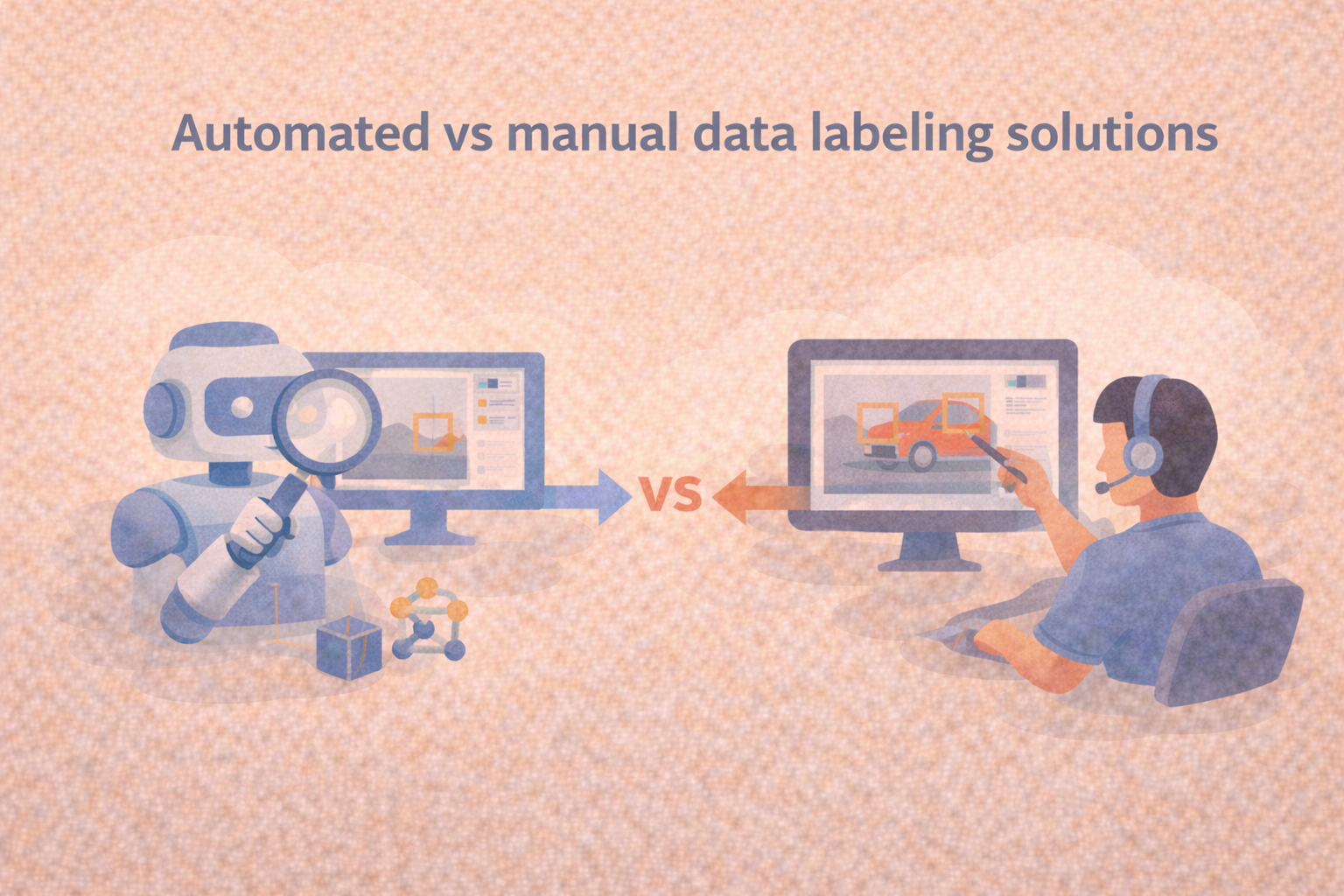
Automated labeling and manual labeling solve different problems. Automation is strongest when labels are predictable and volumes are high. Manual labeling performs better when tasks require judgment, context, or careful handling of edge cases. Most production teams end up with a hybrid approach, using automation to reduce repetitive work and human review to keep datasets trustworthy.
What “automated labeling” and “manual labeling” mean in practice
Automated labeling typically refers to rules, heuristics, weak supervision, or model-assisted labeling that generates labels with minimal human input. Manual labeling refers to humans creating labels from scratch, often with guidelines and reviewer oversight. The gap between them is not philosophical. It shows up in what breaks when requirements change.
Automation can produce labels quickly, but it also reproduces mistakes quickly. Manual labeling is slower, but it can adapt to nuance and handle ambiguous cases that do not fit a fixed pattern. The best choice depends on whether your priority is throughput, accuracy under uncertainty, or the ability to evolve definitions over time.
When automated labeling performs well
Automation is a good fit when the labeling task is stable, the label space is clear, and errors are relatively cheap. It is also a strong option when you have existing models that already perform well on common cases, or when rules can capture the majority of patterns.
Automation tends to work best when you can measure quality continuously and route uncertain cases to humans. Confidence thresholds, validation rules, and sampling-based review help keep automated outputs from quietly degrading the dataset. Without those controls, teams often discover issues only after model performance drops.
When manual labeling is the better choice
Manual labeling performs best when labels require interpretation, domain expertise, or consistent application of subtle guidelines. This is common in safety and compliance tasks, medical imaging, specialized taxonomies, and evaluations where it matters how annotators reason, not just what label they choose.
Manual workflows also shine early in a project when definitions are still forming. Humans can flag ambiguous cases, suggest guideline refinements, and help stabilize the label schema before automation is introduced. Manual labeling is also useful when you need high-trust gold data for benchmarking or calibration.
Why many teams use a hybrid workflow
Hybrid labeling brings the benefits of both approaches. Automation handles repetitive, high-volume cases. Humans focus on the hard cases and validate what automation produces. Over time, the dataset improves and automation becomes more reliable because it is trained or tuned against human-reviewed outcomes.
Hybrid workflows also reduce risk when data shifts. As inputs change, human review can catch new patterns early, and those examples can be used to update models or rules. This prevents automation from drifting silently.
Comparison: automated vs manual labeling
| Dimension | Automated labeling | Manual labeling |
| Speed | Lower marginal cost at scale; setup cost can be significant | Higher variable cost tied to volume and complexity |
| Best for | Repetitive tasks, stable schemas, high-volume pipelines | Ambiguous tasks, expert judgment, early schema development |
| Quality risk | Scales mistakes fast if unchecked | More robust to nuance, but can vary by annotator |
| Adaptability | Requires updates to rules/models when definitions change | Adapts quickly as guidelines evolve |
| Governance | Needs strong monitoring and sampling | Easier to audit decisions with review workflows |
Decision: choosing the right approach by scenario
| Scenario | Recommended approach | Why |
| Clear, repetitive labels with high volume | Automated or hybrid | Automation captures routine patterns efficiently |
| New project with evolving label definitions | Manual first, then hybrid | Humans stabilize guidelines before scaling |
| High-stakes compliance or safety categories | Hybrid with strong review | Human judgment reduces risk and supports auditability |
| Long-tailed edge cases drive model failures | Hybrid | Humans handle rare cases; automation handles the rest |
| Need a gold dataset for evaluation | Manual with strict review | Maximizes trust and consistency for benchmarking |
Frequently Asked Questions
Frequently Asked Questions
Does manual labeling always mean higher quality?
Not automatically. Manual labeling still needs clear guidelines, calibration, and review. Without those, quality can vary between annotators and drift over time.
What is the safest way to introduce automation?
Start with manual labeling to establish a high-quality baseline, then add automation for the easiest cases. Keep a review loop that measures error patterns and updates rules or models based on human feedback.
When does a hybrid workflow become worth it?
Hybrid approaches become valuable as soon as volume increases and edge cases start to matter. They also help when data shifts over time, since human review catches new patterns before they create widespread errors.
Related Content
-
Ways to do document annotation in Label Studio
Learn how to configure XML architectures for text spans, multi-page image conversions, and native PDFs to extract accurate ML training data.
-
How to choose a data labeling platform with integrated project management tools
A practical guide to evaluating labeling platforms that help teams manage projects, coordinate reviewers, and maintain quality as workloads grow.
-
What is data quality assurance for AI?
Data quality assurance for AI is a continuous workflow, not a preprocessing step. Learn the failure modes, quality dimensions, and remediation loops that matter.
-
How to Choose the Right Data Labeling Tool for Your ML Projects
The right data labeling tool can make or break your ML workflow. In this guide, we break down what to look for—from multi-modal support to quality assurance workflows—and where most tools fall short. Whether you're labeling your first dataset or managing enterprise-scale operations, learn how to choose a platform that scales with your team.
-
When generalist annotators aren't enough
Generalist annotators don't fail because they lack expertise. They fail without the right workflow. Learn the tiered model that changes that.
-

Scaling AI Starts with Smarter Data Labeling Jobs
Data labeling is no longer a side task, it’s a strategic function. In this post, we break down the five essential data labeling jobs that drive successful AI projects, from precision annotators to workflow engineers. Learn how the best teams structure their work, enforce quality, and future-proof their pipelines.
-
How to shortlist annotation vendors for your use case
A technical framework for shortlisting annotation vendors: task mapping, four production-fit criteria, pilot design, and data portability before you sign.
-
How to audit the language annotations in your VLA dataset
Learn how to audit VLA dataset language annotations with four structured checks: instruction diversity, grounding, temporal alignment, and density.
-
Human data vs. synthetic data: What's the difference?
Learn the real difference between human and synthetic data, where each breaks down, and how the 10 percent threshold rule determines whether your model holds up in production.
-
How to run a pilot before committing to an annotation vendor
Learn a five-phase annotation vendor pilot framework that tests process, scalability, and contracts, not just label quality, before you sign.
-
Should you build a data collection team or outsource it?
Build vs. outsource your data collection team? Use these three criteria (data complexity, time-to-scale, and domain expertise) to make the right call.
-
Expert annotation uses credentialed specialists, not crowd workers, to label AI training data. Learn how it works, why generalist labeling fails, and how to run the program.
-
Crowdsourced vs. managed labeling: which fits your project?
Discover the three factors that actually determine whether crowdsourced or managed labeling fits your project, beyond the standard scale vs. quality framing.
-

How to find data annotation services that handle both image and audio datasets?
This guide explains what to look for when choosing data annotation services that can reliably handle both image and audio data within the same workflow.
-
How data labeling pricing models compare
Unit costs don't tell the full story. Learn how automation maturity, domain expertise, and ownership model determine your real data labeling spend.
-
How to judge the quality of a vendor's preference data
Learn how to evaluate vendor preference data quality for RLHF using four criteria: annotator qualifications, IAA scores, task coverage, and QA workflow transparency.
-
How to collect preference data for creative and design models
Learn how to collect high-quality preference data for creative AI models using multi-attribute rubrics, structured annotation interfaces, and disagreement routing.
-
Why taste is a data problem: labeling for subjective quality
Subjective quality labeling fails when teams treat annotator disagreement as noise. Learn why disagreement is the signal, and how to measure it.
-
This guide is your starting point for understanding the people, tools, and processes behind high-quality data labeling. Whether you're new to the space or scaling a production pipeline, you’ll find practical insights on workflows, roles, QA strategies, and platform selection, all in one place.
-
What does "human data" actually mean?
"Human data" means three different things across three industries. Here's what it means in AI development, and why the supply is shrinking.
-
What to look for in a data collection partner
Four criteria separate data collection partners that improve model performance from those that delay it. Here's the evaluation framework to use before you sign.
-
Buy an existing speech dataset or commission a custom one?
Choosing a speech dataset? Compare the hidden costs of off-the-shelf corpora against commissioning custom data using this practical decision framework.
-
Top 6 Data Labeling Challenges (and How to Overcome Them)
Data labeling is the backbone of every successful ML project—but it’s also where teams hit the most roadblocks. From quality control to scaling across data types, this post breaks down the six most common challenges and offers practical solutions to help you label smarter, faster, and with more confidence.
-
What is designer-annotated preference data?
Designer-annotated preference data captures multi-dimensional design judgment (typography, hierarchy, color) that standard AI training data can't. Here's how it works.
-
How providers source genuine subject-matter experts
Learn the three criteria data providers use to source SMEs who can anchor AI model quality, beyond résumé credentials and job titles.
-
How to choose a human data provider
Stop choosing human data providers by workforce size. Use this rubric covering domain fit, quality control, and workflow integration to find the right provider.