How to choose a data labeling platform with integrated project management tools
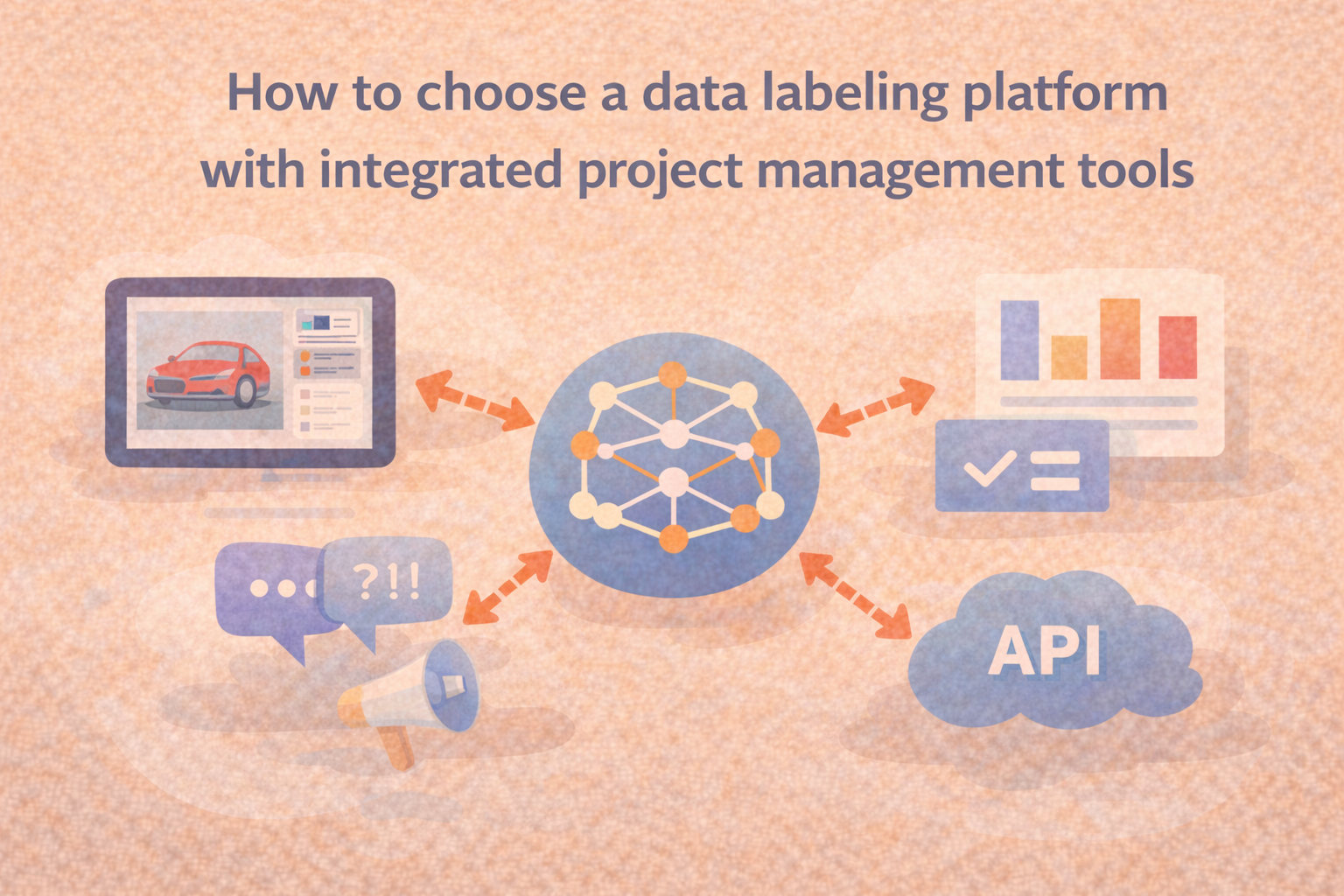
A data labeling platform should help teams do more than annotate. It should help teams run labeling work consistently, especially when projects multiply, contributors rotate, and quality expectations tighten. The strongest platforms make day-to-day coordination feel simple, while keeping enough structure in place to avoid rework and drift.
What to look for in an integrated labeling and project workflow
Integrated project management means the platform supports the operational reality of labeling. That includes how projects are created, how work is assigned and reviewed, how quality is enforced, and how progress is tracked. The goal is predictable execution: fewer handoffs, less manual tracking, and clearer visibility into where the work stands.
Project setup that stays consistent
Most teams label in iterations. New batches arrive, taxonomies evolve, and similar projects get repeated across teams or domains. A platform should make project setup easy to standardize so projects start from a known baseline and changes do not create confusion later. A concrete example of project configuration and management concepts can be found in Label Studio, which outlines how projects are managed inside the labeling workflow.
Task organization that supports real operations
Project management shows up in how tasks are handled once the project is live. Look for task organization that makes it easy to prioritize the right work, segment tasks by metadata, and adjust routing when priorities shift. Strong task views reduce the need for external spreadsheets because teams can see what is happening inside the workflow.
Clear roles, permissions, and review stages
As soon as more than a few people are involved, roles become part of quality control. A platform should support separation between annotators, reviewers, and project owners, with permissions that prevent accidental configuration changes. Review should also be a defined flow, with clear handoffs and rework loops that keep context attached to the task.
Quality controls that create feedback loops
Quality improves when errors lead to better guidance. Look for workflows that make it easy to spot recurring mistakes, update instructions, and confirm the changes are working. Agreement checks, validation rules, and structured review can all help, but the key signal is whether the platform turns quality issues into actionable feedback instead of one-off rejections.
Reporting that answers operational questions quickly
Progress reporting should do more than count completed tasks. It should help you understand what is blocked, where review is slowing down, and which task types cause confusion. When reporting is clear, project leads can adjust staffing, update instructions, or reshape task queues early instead of reacting at the end.
Data connectivity that preserves traceability
Labeling is part of a larger workflow. Imports, exports, and metadata handling determine whether datasets can be reproduced and audited later. A platform that preserves context and keeps outputs traceable supports iteration across training and evaluation cycles. For a broader view of end-to-end workflow themes like collaboration, quality, and governance, Label Studio provides a useful reference point.
Why workflow matters as much as labels
Choosing a data labeling platform with integrated project management comes down to operational fit. Prioritize consistent project setup, practical task coordination, a clear review flow, quality feedback loops, and reporting that reveals bottlenecks early. When those foundations are in place, labeling becomes easier to scale and easier to trust.
Frequently Asked Questions
Frequently Asked Questions
What should a small team prioritize first?
Start with project setup, task coordination, and a review flow that fits your team. These elements shape consistency early and reduce rework later.
How can a team tell whether project management will scale?
Look at how easily projects can be repeated, how smoothly rework is handled, and whether reporting provides a clear view of progress across multiple workstreams.
Do review workflows matter if the team trusts annotators?
Review workflows still help. They provide consistent checks, surface ambiguous cases, and create a feedback loop that improves guidelines.
What causes the most operational overhead in labeling projects?
Manual coordination around assignment, rework, and progress tracking tends to create the most overhead, especially once multiple projects run in parallel.
How do permissions affect quality?
Permissions protect configuration and prevent accidental changes. Clear roles reduce confusion about who can adjust labels, instructions, or exports.
Related Content
-
Ways to do document annotation in Label Studio
Learn how to configure XML architectures for text spans, multi-page image conversions, and native PDFs to extract accurate ML training data.
-
What is data quality assurance for AI?
Data quality assurance for AI is a continuous workflow, not a preprocessing step. Learn the failure modes, quality dimensions, and remediation loops that matter.
-
How to Choose the Right Data Labeling Tool for Your ML Projects
The right data labeling tool can make or break your ML workflow. In this guide, we break down what to look for—from multi-modal support to quality assurance workflows—and where most tools fall short. Whether you're labeling your first dataset or managing enterprise-scale operations, learn how to choose a platform that scales with your team.
-
When generalist annotators aren't enough
Generalist annotators don't fail because they lack expertise. They fail without the right workflow. Learn the tiered model that changes that.
-

Scaling AI Starts with Smarter Data Labeling Jobs
Data labeling is no longer a side task, it’s a strategic function. In this post, we break down the five essential data labeling jobs that drive successful AI projects, from precision annotators to workflow engineers. Learn how the best teams structure their work, enforce quality, and future-proof their pipelines.
-
How to shortlist annotation vendors for your use case
A technical framework for shortlisting annotation vendors: task mapping, four production-fit criteria, pilot design, and data portability before you sign.
-
How to audit the language annotations in your VLA dataset
Learn how to audit VLA dataset language annotations with four structured checks: instruction diversity, grounding, temporal alignment, and density.
-
Human data vs. synthetic data: What's the difference?
Learn the real difference between human and synthetic data, where each breaks down, and how the 10 percent threshold rule determines whether your model holds up in production.
-
How to run a pilot before committing to an annotation vendor
Learn a five-phase annotation vendor pilot framework that tests process, scalability, and contracts, not just label quality, before you sign.
-
Should you build a data collection team or outsource it?
Build vs. outsource your data collection team? Use these three criteria (data complexity, time-to-scale, and domain expertise) to make the right call.
-
Expert annotation uses credentialed specialists, not crowd workers, to label AI training data. Learn how it works, why generalist labeling fails, and how to run the program.
-
Crowdsourced vs. managed labeling: which fits your project?
Discover the three factors that actually determine whether crowdsourced or managed labeling fits your project, beyond the standard scale vs. quality framing.
-

How to find data annotation services that handle both image and audio datasets?
This guide explains what to look for when choosing data annotation services that can reliably handle both image and audio data within the same workflow.
-
How data labeling pricing models compare
Unit costs don't tell the full story. Learn how automation maturity, domain expertise, and ownership model determine your real data labeling spend.
-
How to judge the quality of a vendor's preference data
Learn how to evaluate vendor preference data quality for RLHF using four criteria: annotator qualifications, IAA scores, task coverage, and QA workflow transparency.
-
How to collect preference data for creative and design models
Learn how to collect high-quality preference data for creative AI models using multi-attribute rubrics, structured annotation interfaces, and disagreement routing.
-
Why taste is a data problem: labeling for subjective quality
Subjective quality labeling fails when teams treat annotator disagreement as noise. Learn why disagreement is the signal, and how to measure it.
-
This guide is your starting point for understanding the people, tools, and processes behind high-quality data labeling. Whether you're new to the space or scaling a production pipeline, you’ll find practical insights on workflows, roles, QA strategies, and platform selection, all in one place.
-
What does "human data" actually mean?
"Human data" means three different things across three industries. Here's what it means in AI development, and why the supply is shrinking.
-
What to look for in a data collection partner
Four criteria separate data collection partners that improve model performance from those that delay it. Here's the evaluation framework to use before you sign.
-
Buy an existing speech dataset or commission a custom one?
Choosing a speech dataset? Compare the hidden costs of off-the-shelf corpora against commissioning custom data using this practical decision framework.
-
Top 6 Data Labeling Challenges (and How to Overcome Them)
Data labeling is the backbone of every successful ML project—but it’s also where teams hit the most roadblocks. From quality control to scaling across data types, this post breaks down the six most common challenges and offers practical solutions to help you label smarter, faster, and with more confidence.
-
What is designer-annotated preference data?
Designer-annotated preference data captures multi-dimensional design judgment (typography, hierarchy, color) that standard AI training data can't. Here's how it works.
-
How providers source genuine subject-matter experts
Learn the three criteria data providers use to source SMEs who can anchor AI model quality, beyond résumé credentials and job titles.
-
How to choose a human data provider
Stop choosing human data providers by workforce size. Use this rubric covering domain fit, quality control, and workflow integration to find the right provider.