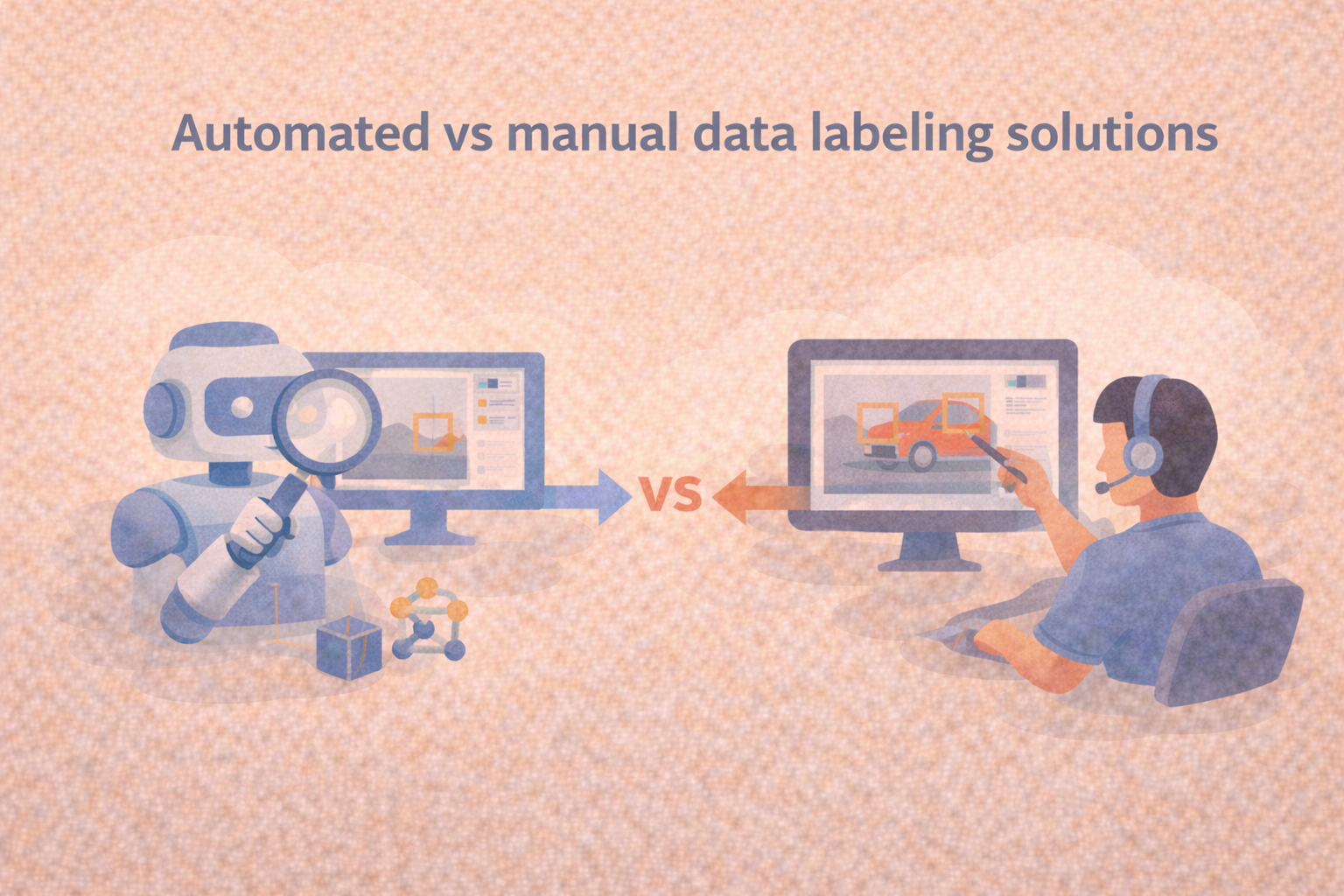
How data labeling pricing models compare
Two vendor quotes arrive. One is $0.02 per label. The other is $0.10 per label. Your team picks the lower rate, runs the project, and ships the model. Six months later, the model requires significant retraining because the initial labels didn't meet quality standards. The retraining cost can exceed the original labeling budget. The $0.02 rate was accurate. The comparison framework didn't account for long-term maintenance.
TL;DR
Pricing models (per-label, per-hour, per-project, SaaS) bundle costs differently, making simple rate comparisons misleading.
Expert annotators for LLM alignment cost 20–40x more than generic crowd workers.
Choosing between a platform and a managed service determines whether you pay costs upfront or encounter them later as overhead.
Human-in-the-loop methods are growing at a 33 percent CAGR while fully manual workflows stagnate.
Choose models based on data sensitivity and automation level, not unit price.
Why unit-cost benchmarks mislead budget planning
A per-label rate tells you the cost of one correct annotation from one annotator on one specific task. It tells you nothing about rework rates, QA dispute handling, or tooling overhead. It also won't tell you whether the pricing model scales with your project or breaks at volume.
One-third of organizations cite manual data labeling as a top data preparation challenge, per IDC research. Unstructured data (text, image, video) is expected to make up 90 percent of all business data. High data volume makes pricing model selection a structural decision rather than a rate-shopping exercise.
The four pricing models and what each one includes
Each pricing model bundles cost components differently. The same task can look cheap or expensive depending on what's included in the quoted number.
Per-label (consumption-based)
You pay a fixed amount for each completed annotation object, entity, or image. Annotation pricing ranges from $0.015 per object for keypoint annotations to $0.02 per entity for NLP tasks. Per-image pricing runs $0.05 to $0.25 depending on complexity. Volume-based discounts are common; TELUS International structures pricing on this consumption basis with annual or multiyear contracts.
What's often excluded: tooling costs, QA review, and rework for rejected annotations. If your rejection rate is high, your effective cost per usable label climbs well above the quoted rate.
Per-hour
You pay for annotator time. Hourly billing provides budget predictability but shifts all quality risk to the buyer. If throughput is low or accuracy drops, the meter runs regardless. Suitable for projects where task definitions are still evolving and rigid per-label pricing would require constant renegotiation.
Per-project (fixed-scope)
A vendor quotes a fixed fee for a specific dataset. Quality and timelines are contractually specified. Works well when you have a stable, well-scoped dataset with clear acceptance criteria. The risk: scope changes or quality disputes create costly renegotiations.
Platform SaaS
You pay a subscription for labeling software and run your own annotators or internal team. Tooling is included; labor is not. Labor typically accounts for 60 to 80 percent of total labeling costs. Tooling runs 10 to 15 percent, and QA another 15 to 20 percent. A platform model makes those line items visible and manageable rather than bundled into a vendor's margin.
How domain expertise changes the math
The pricing model is the structure. Domain expertise is the multiplier applied to it.
Most per-label benchmarks assume annotators doing general classification or bounding box tasks on common object categories. That assumption breaks when the task requires judgment. Sentiment in financial disclosures, code review for subtle bugs, LLM output ranking, and medical imaging each require annotators who cannot be swapped out. One estimate from a leading AI lab puts expert annotators at 20 to 40 times the hourly cost of generic crowd workers.
The AI data labeling market was $2.83 billion in 2026. It is projected to reach $18.23 billion by 2035 at a 23 percent CAGR. Growth stems from more than volume. High-context tasks for LLM alignment and GenAI evaluation are shifting the market toward specialized labor. Commodity rate benchmarks published every year are increasingly irrelevant for the use cases driving the most spend.
For high-volume bounding box tasks on common object classes, geographic arbitrage through a crowd-labeling service is still the correct call. The expert premium argument applies specifically to tasks requiring judgment, domain knowledge, or natural-language nuance. Teams that apply specialist pricing to commodity annotation tasks over-engineer the solution and waste budget. The first question to answer before choosing a pricing model is whether your task type demands interchangeable annotators or irreplaceable ones.
Total cost of ownership: platform vs. managed service
The ownership model determines which costs appear on your invoice and which appear on your engineering team's calendar.
What managed service pricing includes and excludes
A managed service contract covers annotator recruitment, training, QA, and delivery. What it typically does not cover: the engineering time your team spends writing guidelines, reviewing disputed labels, and retraining models when label quality drifts. Outsourced labeling held 54.85 percent of the market in 2025 (Precedence Research), but the in-house segment is growing faster. Enterprises are recognizing how much invisible overhead managed services transfer back to their teams.
The largest AI labs spend $1 to $2 billion per year on human-in-the-loop reinforcement learning and data pipelines (Data Gravity). Some forecasts put total data labeling budgets above $10 billion annually across the top 10 labs by 2027. At that scale, labeling is a strategic capability, not a vendor relationship.
What platform ownership costs
A SaaS labeling platform surfaces costs that managed services bury. You see tooling fees, annotator throughput, QA review cycles, and inter-annotator agreement all as measurable line items. The engineering overhead is real and upfront, but it gives you control over the quality variables that drive retraining cycles.
Scoutbee, a supply chain intelligence company, ran its labeling practice on Label Studio Enterprise with human-in-the-loop review workflows. The results: a 20 times reduction in labeling and model maintenance time, model accuracy above 90 percent across millions of documents. Revenue from ML-based products grew 2 to 3 times. The platform cost did not disappear. The retraining cost and the maintenance drag did.
Building a TCO picture
When you sketch a TCO comparison, the line items shift by ownership model. A managed service front-loads vendor fees and hides engineering overhead. A platform model front-loads tooling and setup but makes labor costs visible and controllable. Your break-even depends on two variables: how often your process generates rework, and how much engineering time you spend correcting vendor output.
How automation maturity reshapes what you pay
Where you sit on the automation spectrum determines which pricing model fits.
Manual workflows retained 78.1 percent of market share in 2025 (Mordor Intelligence). For teams at that stage, per-hour or managed service pricing is often the right match. Costs are predictable, no model-assisted infrastructure is needed, and the workflow is simple to manage. The moment you introduce model-assisted labeling or active learning, the math changes. Human review time drops, throughput rises, and the fixed cost of a platform subscription starts paying for itself in labor savings.
The ceiling on automation gains is substantial. LLM-generated labeling programs can reduce costs by roughly 500 times compared to direct annotation, per University of Wisconsin-Madison research. Direct GPT-4 labeling of a 7,500-point dataset cost $1,200; program-based labeling cost $0.70. The 500x cost reduction represents a ceiling case for low-complexity text classification rather than a universal benchmark. But it illustrates why semi-supervised and human-in-the-loop methods are accelerating at a 33.15 percent CAGR while fully manual workflows stagnate.
Sense Street, a financial technology company, structured its labeling practice around platform-driven workflows across five languages. Sense Street achieved a 120 percent increase in annotations per labeler and a fourfold expansion in team capacity (Sense Street case study).
Align the pricing model with your project needs
The pricing model follows from your situation, not from the lowest rate available. A few decision points that typically determine the fit:
High-volume, simple tasks with no sensitive data: Use per-label outsourcing or a managed service. Focus on throughput and volume discounts. Engineering overhead is low because quality review is straightforward.
Specialized domain (medical, legal, code, LLM alignment), any volume: Per-hour or per-project contracts with vetted domain experts, or a platform where your internal subject matter experts do the work. The 20 to 40 times expert premium is real. Price it in from the start.
Data sensitivity or compliance requirements (HIPAA, SOC2, unreleased product data): Platform-first or fully managed in-house. Outsourcing sensitive data to a crowd-labeling service creates liability that doesn't appear in the per-label rate.
Active learning or model-assisted workflows: SaaS platform pricing. You're paying for software capability alongside labor. Per-label outsourcing does not give you the feedback loop that makes AI-assisted annotation worthwhile.
End-to-end dataset creation with no internal labeling team: A fully managed data service. For teams requiring end-to-end dataset creation, HumanSignal Services provides physical data labs where domain experts and engineers collaborate on multimodal data. The pricing is project-scoped, which eliminates internal engineering overhead entirely.
Teams building an internal practice can start with no tooling cost on Label Studio's free open-source tier and scale to managed hosting as volume grows. HumanSignal's pricing tiers follow the same ownership logic: Starter Cloud at $99 per month adds managed infrastructure, and Enterprise adds LLM-as-a-judge evaluation and SOC2 compliance. Each step up trades upfront cost for control: over QA, over automation, over the feedback loop that per-label outsourcing doesn't give you.
Total cost, not unit rate
Both quotes you received at the start were accurate on rate. Total cost depends on what each rate excludes, and the two quotes were answering different questions. The question worth asking: what is the full cost of producing labels accurate enough that your model doesn't need retraining in six months?
Identify your automation maturity first. Then identify your data sensitivity. Those two variables select the pricing model. Once the model is right, the rate negotiation is a rounding error. A practical starting point: examine how your current setup handles QA and rework (internal data labeling guide). That is where the real cost of the wrong model shows up first.
Related Content
-
Ways to do document annotation in Label Studio
Learn how to configure XML architectures for text spans, multi-page image conversions, and native PDFs to extract accurate ML training data.
-
How to choose a data labeling platform with integrated project management tools
A practical guide to evaluating labeling platforms that help teams manage projects, coordinate reviewers, and maintain quality as workloads grow.
-
What is data quality assurance for AI?
Data quality assurance for AI is a continuous workflow, not a preprocessing step. Learn the failure modes, quality dimensions, and remediation loops that matter.
-
How to Choose the Right Data Labeling Tool for Your ML Projects
The right data labeling tool can make or break your ML workflow. In this guide, we break down what to look for—from multi-modal support to quality assurance workflows—and where most tools fall short. Whether you're labeling your first dataset or managing enterprise-scale operations, learn how to choose a platform that scales with your team.
-
When generalist annotators aren't enough
Generalist annotators don't fail because they lack expertise. They fail without the right workflow. Learn the tiered model that changes that.
-

Scaling AI Starts with Smarter Data Labeling Jobs
Data labeling is no longer a side task, it’s a strategic function. In this post, we break down the five essential data labeling jobs that drive successful AI projects, from precision annotators to workflow engineers. Learn how the best teams structure their work, enforce quality, and future-proof their pipelines.
-
How to shortlist annotation vendors for your use case
A technical framework for shortlisting annotation vendors: task mapping, four production-fit criteria, pilot design, and data portability before you sign.
-
How to audit the language annotations in your VLA dataset
Learn how to audit VLA dataset language annotations with four structured checks: instruction diversity, grounding, temporal alignment, and density.
-
Human data vs. synthetic data: What's the difference?
Learn the real difference between human and synthetic data, where each breaks down, and how the 10 percent threshold rule determines whether your model holds up in production.
-
How to run a pilot before committing to an annotation vendor
Learn a five-phase annotation vendor pilot framework that tests process, scalability, and contracts, not just label quality, before you sign.
-
Should you build a data collection team or outsource it?
Build vs. outsource your data collection team? Use these three criteria (data complexity, time-to-scale, and domain expertise) to make the right call.
-
Expert annotation uses credentialed specialists, not crowd workers, to label AI training data. Learn how it works, why generalist labeling fails, and how to run the program.
-
Crowdsourced vs. managed labeling: which fits your project?
Discover the three factors that actually determine whether crowdsourced or managed labeling fits your project, beyond the standard scale vs. quality framing.
-

How to find data annotation services that handle both image and audio datasets?
This guide explains what to look for when choosing data annotation services that can reliably handle both image and audio data within the same workflow.
-
How to judge the quality of a vendor's preference data
Learn how to evaluate vendor preference data quality for RLHF using four criteria: annotator qualifications, IAA scores, task coverage, and QA workflow transparency.
-
How to collect preference data for creative and design models
Learn how to collect high-quality preference data for creative AI models using multi-attribute rubrics, structured annotation interfaces, and disagreement routing.
-
Why taste is a data problem: labeling for subjective quality
Subjective quality labeling fails when teams treat annotator disagreement as noise. Learn why disagreement is the signal, and how to measure it.
-
This guide is your starting point for understanding the people, tools, and processes behind high-quality data labeling. Whether you're new to the space or scaling a production pipeline, you’ll find practical insights on workflows, roles, QA strategies, and platform selection, all in one place.
-
What does "human data" actually mean?
"Human data" means three different things across three industries. Here's what it means in AI development, and why the supply is shrinking.
-
What to look for in a data collection partner
Four criteria separate data collection partners that improve model performance from those that delay it. Here's the evaluation framework to use before you sign.
-
Buy an existing speech dataset or commission a custom one?
Choosing a speech dataset? Compare the hidden costs of off-the-shelf corpora against commissioning custom data using this practical decision framework.
-
Top 6 Data Labeling Challenges (and How to Overcome Them)
Data labeling is the backbone of every successful ML project—but it’s also where teams hit the most roadblocks. From quality control to scaling across data types, this post breaks down the six most common challenges and offers practical solutions to help you label smarter, faster, and with more confidence.
-
What is designer-annotated preference data?
Designer-annotated preference data captures multi-dimensional design judgment (typography, hierarchy, color) that standard AI training data can't. Here's how it works.
-
How providers source genuine subject-matter experts
Learn the three criteria data providers use to source SMEs who can anchor AI model quality, beyond résumé credentials and job titles.
-
How to choose a human data provider
Stop choosing human data providers by workforce size. Use this rubric covering domain fit, quality control, and workflow integration to find the right provider.