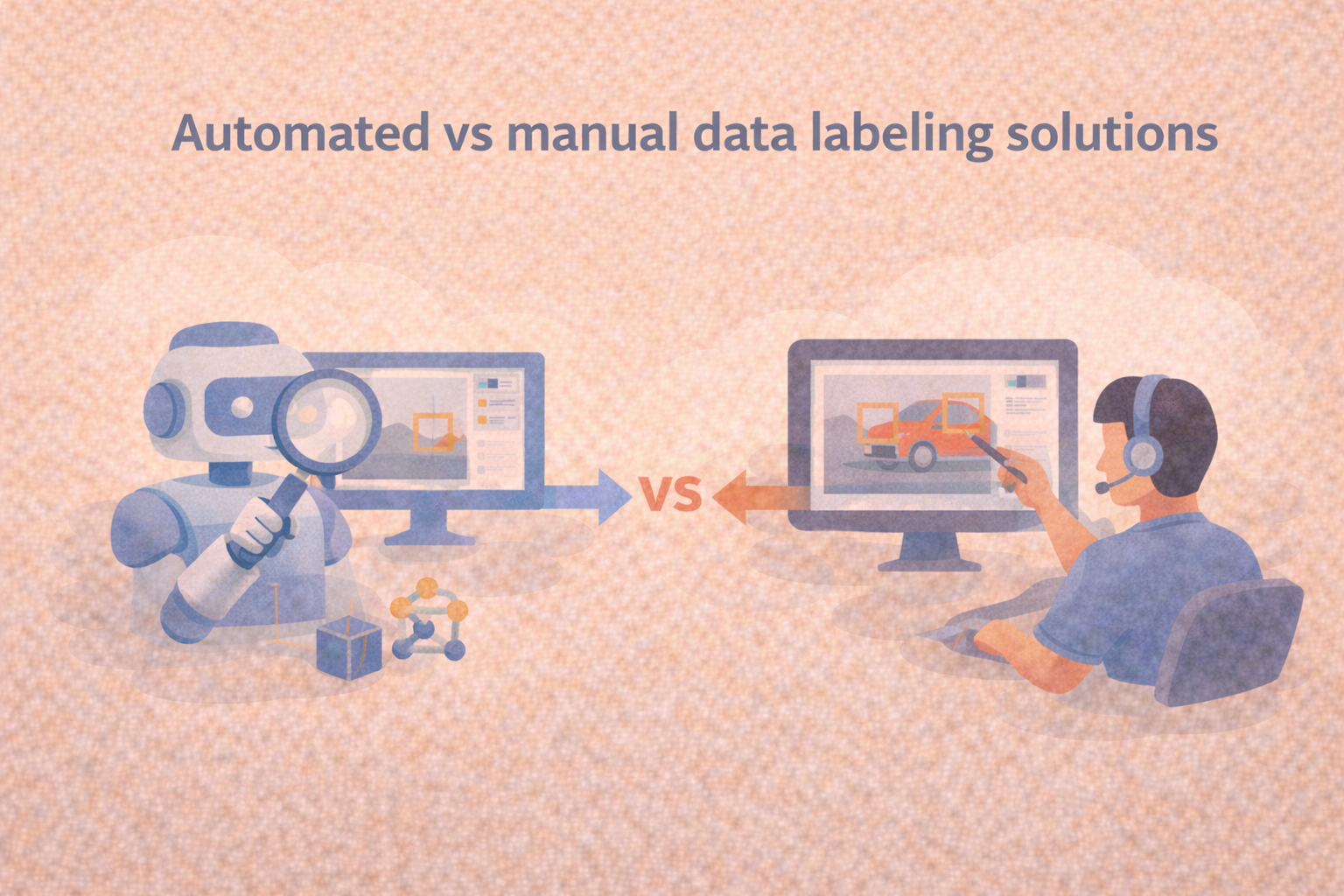
Human data vs. synthetic data: What's the difference?
A team cuts their annotation budget. They replace a third, then half, then most of their human-labeled training examples with synthetic data generated by an LLM. Benchmarks hold steady. They ship. Three weeks later, production failures cluster on the edge cases. Human annotators once flagged those rare, ambiguous inputs. The synthetic generator smoothed them into confident but incorrect predictions. Fixing those errors often costs more than the original annotation budget. The issue usually isn't the synthetic data itself. The gap is not knowing where relying on it stops being safe.
TL;DR
Human and synthetic data differ in origin, fidelity, and what each can replicate.
Synthetic data works well for rare scenarios, de-biasing underrepresented groups, and privacy-sensitive contexts.
Training purely on synthetic data causes model collapse, per peer-reviewed research.
Replacing the final 10 percent of human data triggers severe degradation (Ashok & May, 2025).
125 to 200 human-labeled points recover what more synthetic volume cannot.
What human data and synthetic data actually are
Teams rely on human data (annotations, preference rankings, labeled examples, and raw text, images, and audio produced without AI assistance) to capture how the world actually behaves, including the messy and rare events that make models effective in production.
Synthetic data is algorithmically generated to approximate real-world distributions. It comes in three main forms. Sample-based generation uses AI models that learn from real data and produce statistically similar outputs. Rule-based mock data follows manually coded constraints. LLM-based generation prompts language models to produce examples in a target format. Each method achieves a different level of fidelity to the original distribution. Synthetic data learns statistical patterns from real data; masking individual records is a separate process that achieves a different kind of fidelity. Choosing the right method determines whether the resulting data matches the real-world distribution you need.
The difference matters because the synthetic data generation market is projected to grow from $288 million in 2022 to $2.3 billion by 2030. Gartner predicts synthetic data will surpass real-world data in AI training by that year. Understanding what each type carries, and what it can't replicate, determines whether that growth produces better models or more confident failures.
Where synthetic data gives teams a real advantage
Synthetic data serves specific functions where it outperforms human data collection:
Rare scenario coverage. Real-world datasets underrepresent edge cases by definition. Dangerous events, equipment failures, and unusual user inputs are rare precisely because they're rare. Synthetic generation can produce thousands of examples of a scenario that appears once in a million real records. MIT research from Kalyan Veeramachaneni's lab confirms that synthetic augmentation substantially improves model performance on these tail scenarios.
De-biasing underrepresented groups. A dataset collected from real-world sources reflects real-world inequities. If one demographic appears in 2 percent of your training data, the model will underserve them. You can generate synthetic examples for that group at whatever ratio the task requires, without waiting to collect more real-world data.
Privacy-sensitive and regulated contexts. Medical records, financial transactions, and behavioral data fall under regulations that restrict how real records can be used in training. A survey of synthetic data applications across these domains shows that synthetic generation reduces legal exposure while preserving the statistical structure needed for training.
Where synthetic data quietly breaks down
Model collapse
Generative models trained on their own outputs lose diversity and accuracy over time. Peer-reviewed research from Nature, Oxford, and Cambridge confirms it. Models become less accurate each time they learn from their own outputs, and the gap widens with every cycle. By the time collapse shows up in production, retraining from a clean dataset is the only fix.
Privacy leakage
Synthetic data is widely sold as a privacy solution. Generate data that looks like your sensitive records without exposing them. The Royal Society's analysis shows why that framing is incomplete. Synthetic generators learn from real data, and under certain conditions that learning can be partially reversed to infer details about individuals in the original dataset. Privacy compliance and synthetic generation solve different problems and require separate controls.
The outlier problem makes this worse. Synthetic generators struggle to represent rare individuals or extreme values accurately. Extreme values get smoothed out of the distribution. When forced in, they can point back to specific individuals. Teams that treat synthetic generation as a GDPR or HIPAA substitute are carrying a risk they haven't measured.
Opaque failures in production
Synthetic data can function as a manufactured reflection of reality that becomes unintentionally distorted. TechPolicy.Press documents how that distortion leads to opaque decision-making in autonomous agents. AI incidents reached 362 documented cases in 2025, per Stanford HAI. That number rises as models trained on synthetic data encounter real-world distributions they were never anchored to.
The 10 percent rule: how little human data you actually need
What the research shows
Replacing human-labeled training data with synthetic equivalents follows a predictable decay curve, until it hits a cliff. The findings are precise: replacing up to 90 percent of training data with synthetic points produces only marginal performance decreases. The model degrades slowly and predictably as synthetic data replaces more of the human-labeled set.
Then the pattern breaks.
The model suffers severe degradation when the final 10 percent of human data is replaced. The gradual slide stops; it drops. The final 10 percent carries the real-world distribution of edge cases and rare events. Those inputs determine whether a model holds up on unfamiliar data.
The recovery number is just as precise. As few as 125 to 200 human-generated data points can substantially restore a model that degraded from fully synthetic training. Teams require an order of magnitude more synthetic data to match the performance gain of 200 human points. The 10:1 ratio inverts standard budget logic. Maximum synthetic volume is rarely the cheapest path to a reliable model. Protecting a small, well-curated human set and building synthetic volume around it is.
What this means in practice
The 10 percent threshold shifts the focus: the question is no longer whether to use synthetic data, but how to protect the human anchor. 63 percent of organizations already favor a hybrid approach. LLMs are projected to exhaust human text data between 2026 and 2032. Data scarcity will make synthetic generation unavoidable at scale. Protecting the human anchor becomes the central architectural decision.
Teams that cut annotation budgets without understanding the threshold often cut past it. The production failures that follow cluster on edge cases and ambiguous inputs: the signature of a model that lost its anchor. Benchmark scores held because benchmarks don't capture the tail. Production does.
Where the threshold applies
The 10 percent number comes from one study design. The same pattern holds across different types of AI work, though the exact ratio shifts by domain. A model that needs to detect rare defects requires more human data than one that generates text. Some human anchor is non-negotiable, and less than you'd expect is enough to maintain it.
Putting the mix into practice
The 10 percent threshold is a principle. Operationally, that means a structured validation workflow. Human-labeled data sets the ground truth, and synthetic batches are checked against it before entering the training set. The human set is not "some real data mixed in." It is the measurement instrument that tells you whether the synthetic data is doing what you think it is.
Geberit implemented this validation workflow using HumanSignal's Prompts feature, validating LLM-labeled data against human ground truth before use. The result was 5x labeling throughput and 95 percent annotation accuracy against ground truth at scale. Cost savings ran 4-5x compared to their previous manual and semi-automated process. The synthetic generation created the volume; the human ground truth set determined whether that volume was trustworthy.
Sense Street, which builds generative language models for capital markets, structured a similar separation between automated pre-labeling and human review across five languages. Their annotation operation expanded by 400 percent while labels produced increased by 150 percent. The human review layer didn't slow the operation. It made the scale achievable because quality held as volume grew. Both workflows follow the same architectural logic: synthetic data handles volume, and the human anchor makes that volume count.
What this means for your labeling strategy
The team in the opening scenario didn't make a budgeting mistake. They made an architectural one. They removed the anchor from their training process without knowing it was the anchor. Every production failure that followed was predictable from the moment the last human-labeled examples left the dataset.
The research is specific enough to stand behind: protect at least 10 percent of your training data as human-labeled ground truth. Validate synthetic batches against it. Treat that set as the one part of your pipeline that doesn't scale down with budget pressure. Synthetic generation provides the volume. Human data makes that volume reliable. Cutting the anchor to save annotation costs tends to cost more when production breaks.
Related Content
-
Ways to do document annotation in Label Studio
Learn how to configure XML architectures for text spans, multi-page image conversions, and native PDFs to extract accurate ML training data.
-
How to choose a data labeling platform with integrated project management tools
A practical guide to evaluating labeling platforms that help teams manage projects, coordinate reviewers, and maintain quality as workloads grow.
-
What is data quality assurance for AI?
Data quality assurance for AI is a continuous workflow, not a preprocessing step. Learn the failure modes, quality dimensions, and remediation loops that matter.
-

How to Choose the Right Data Labeling Tool for Your ML Projects
The right data labeling tool can make or break your ML workflow. In this guide, we break down what to look for—from multi-modal support to quality assurance workflows—and where most tools fall short. Whether you're labeling your first dataset or managing enterprise-scale operations, learn how to choose a platform that scales with your team.
-
When generalist annotators aren't enough
Generalist annotators don't fail because they lack expertise. They fail without the right workflow. Learn the tiered model that changes that.
-

Scaling AI Starts with Smarter Data Labeling Jobs
Data labeling is no longer a side task, it’s a strategic function. In this post, we break down the five essential data labeling jobs that drive successful AI projects, from precision annotators to workflow engineers. Learn how the best teams structure their work, enforce quality, and future-proof their pipelines.
-
How to shortlist annotation vendors for your use case
A technical framework for shortlisting annotation vendors: task mapping, four production-fit criteria, pilot design, and data portability before you sign.
-
How to audit the language annotations in your VLA dataset
Learn how to audit VLA dataset language annotations with four structured checks: instruction diversity, grounding, temporal alignment, and density.
-
How to run a pilot before committing to an annotation vendor
Learn a five-phase annotation vendor pilot framework that tests process, scalability, and contracts, not just label quality, before you sign.
-
Should you build a data collection team or outsource it?
Build vs. outsource your data collection team? Use these three criteria (data complexity, time-to-scale, and domain expertise) to make the right call.
-
Expert annotation uses credentialed specialists, not crowd workers, to label AI training data. Learn how it works, why generalist labeling fails, and how to run the program.
-
Crowdsourced vs. managed labeling: which fits your project?
Discover the three factors that actually determine whether crowdsourced or managed labeling fits your project, beyond the standard scale vs. quality framing.
-
How to find data annotation services that handle both image and audio datasets?
This guide explains what to look for when choosing data annotation services that can reliably handle both image and audio data within the same workflow.
-
How data labeling pricing models compare
Unit costs don't tell the full story. Learn how automation maturity, domain expertise, and ownership model determine your real data labeling spend.
-
How to judge the quality of a vendor's preference data
Learn how to evaluate vendor preference data quality for RLHF using four criteria: annotator qualifications, IAA scores, task coverage, and QA workflow transparency.
-
How to collect preference data for creative and design models
Learn how to collect high-quality preference data for creative AI models using multi-attribute rubrics, structured annotation interfaces, and disagreement routing.
-
Why taste is a data problem: labeling for subjective quality
Subjective quality labeling fails when teams treat annotator disagreement as noise. Learn why disagreement is the signal, and how to measure it.
-
This guide is your starting point for understanding the people, tools, and processes behind high-quality data labeling. Whether you're new to the space or scaling a production pipeline, you’ll find practical insights on workflows, roles, QA strategies, and platform selection, all in one place.
-
What does "human data" actually mean?
"Human data" means three different things across three industries. Here's what it means in AI development, and why the supply is shrinking.
-
What to look for in a data collection partner
Four criteria separate data collection partners that improve model performance from those that delay it. Here's the evaluation framework to use before you sign.
-
Buy an existing speech dataset or commission a custom one?
Choosing a speech dataset? Compare the hidden costs of off-the-shelf corpora against commissioning custom data using this practical decision framework.
-
Top 6 Data Labeling Challenges (and How to Overcome Them)
Data labeling is the backbone of every successful ML project—but it’s also where teams hit the most roadblocks. From quality control to scaling across data types, this post breaks down the six most common challenges and offers practical solutions to help you label smarter, faster, and with more confidence.
-
What is designer-annotated preference data?
Designer-annotated preference data captures multi-dimensional design judgment (typography, hierarchy, color) that standard AI training data can't. Here's how it works.
-
How providers source genuine subject-matter experts
Learn the three criteria data providers use to source SMEs who can anchor AI model quality, beyond résumé credentials and job titles.
-
How to choose a human data provider
Stop choosing human data providers by workforce size. Use this rubric covering domain fit, quality control, and workflow integration to find the right provider.