Automated metrics vs human evaluation: when each is the right choice
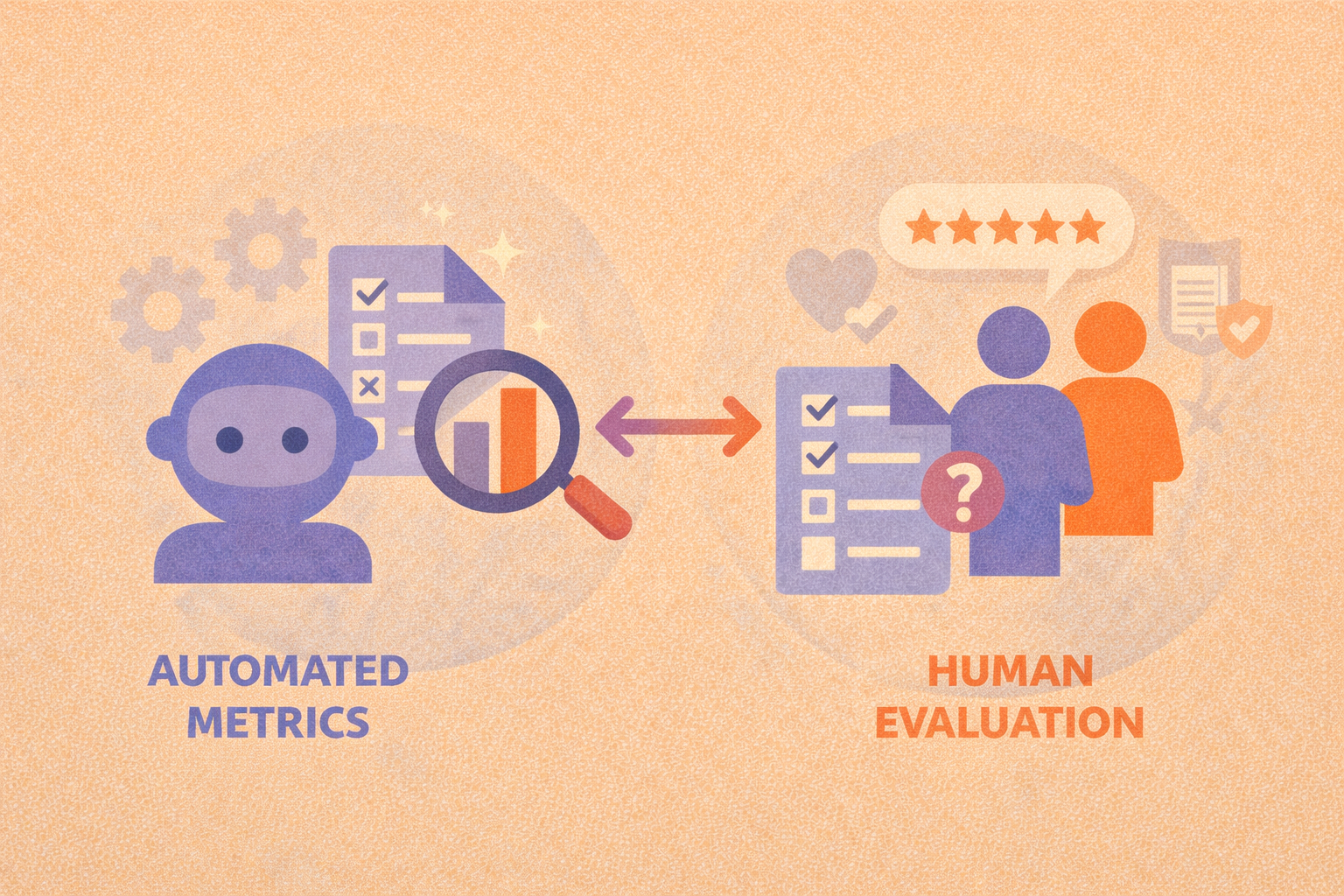
About A: Automated evaluation metrics
Automated evaluation metrics score model outputs using predefined rules. They excel at consistency and scale: the same input produces the same score every time, and you can evaluate thousands of examples quickly.
Automated metrics are most effective when there is clear ground truth or an objective scoring method. Structured prediction tasks often fit well: classification, extraction, and many ranking problems. Automated metrics are also essential for regression testing. They let teams answer, “Did this model change make things better or worse?” without requiring a fresh round of human review on every iteration.
The limitation is that automated metrics can miss what humans care about. They struggle with nuance, context, and subjective quality. In conversational systems, for example, a response can be technically relevant but unhelpful. In safety-sensitive systems, an answer can be accurate but inappropriate. Automated metrics can also be gamed: models may learn to optimize the metric rather than the underlying user goal.
About B: Human evaluation
Human evaluation uses reviewers to judge model outputs, often with a rubric. It’s the best approach when quality depends on context, tone, policy judgment, or user experience.
Human evaluation can capture what automated metrics cannot: whether an answer is actually helpful, whether it follows policy boundaries, whether the reasoning is coherent, and whether the system behaves consistently across ambiguous prompts. Humans are also better at discovering new failure modes because they notice “weirdness” that isn’t captured by a metric.
The tradeoff is consistency and cost. Human raters can disagree, drift over time, or interpret criteria differently unless the rubric is clear and calibration is ongoing. Human evaluation also takes longer, which makes it harder to run on every minor model change.
In practice, human evaluation is most valuable when it’s used strategically: calibrating rubrics, validating high-risk slices, and making go/no-go decisions when stakes are high.
Comparison
| Dimension | Automated metrics | Human evaluation |
| Core strength | Speed and repeatability | Nuance and judgment |
| Best for | Regression checks, large-scale scoring, stable trends | Quality validation, policy/tone assessment, edge-case review |
| Consistency | High (deterministic scoring) | Variable (needs rubrics + calibration) |
| Scalability | High | Moderate to low |
| Time to run | Fast | Slower |
| What it catches well | Clear correctness changes, systematic regressions | Subtle failure modes, UX issues, unsafe or off-policy behavior |
| What it misses | Contextual quality, “helpfulness,” intent mismatch | Small numeric differences, broad coverage unless sampling is large |
| Risk of gaming | Higher (metric optimization) | Lower (harder to “overfit” humans, though rubric can be exploited) |
| Maintenance needs | Metric upkeep and dataset management | Rater training, calibration, rubric refinement |
| Ideal use pattern | Always-on baseline | Periodic deep checks + high-risk gates |
Suggestion
Treat automated metrics as your always-on monitoring layer and human evaluation as your calibration and decision layer.
A simple hybrid approach:
- Use automated metrics on every model change for fast regression detection.
- Sample outputs for human review on critical slices (high-risk topics, new use cases, edge cases).
- Run periodic human evaluation rounds to recalibrate rubrics and catch new failure modes.
- When automated and human signals disagree, prioritize investigation over “picking a winner.”
This approach keeps iteration fast while still grounding your evaluation in real quality and real risk.
Conclusion
Automated metrics keep evaluation consistent at scale. Human evaluation captures the nuance that metrics miss. The most reliable evaluation workflows assign each a clear role: automation for repeatability, humans for judgment, and a structured process for reconciling disagreements between the two.
Frequently Asked Questions
Frequently Asked Questions
Can automated metrics fully replace human evaluation?
No. Automated metrics scale well but cannot capture nuance, context, or subjective quality without human judgment.
When is human evaluation absolutely necessary?
Human evaluation is critical for conversational systems, safety-sensitive use cases, and any task where tone, intent, or policy interpretation matters.
Are automated metrics more objective than humans?
They are more consistent, but only within the boundaries of what they measure. Poorly chosen metrics can still produce misleading results.
How often should human evaluation be run?
Typically on a sampled basis: during calibration, before major releases, and when automated signals suggest unexpected behavior.
What happens when automated metrics and human judgments disagree?
Disagreement should trigger investigation. It often reveals gaps in metrics, unclear rubrics, or emerging failure modes.
Related Content
-
How to build a red teaming dataset
Learn how to build a red teaming dataset with a reusable schema, three sourcing tiers, expert annotation, and a maintenance workflow that keeps your model's safety coverage current.
-
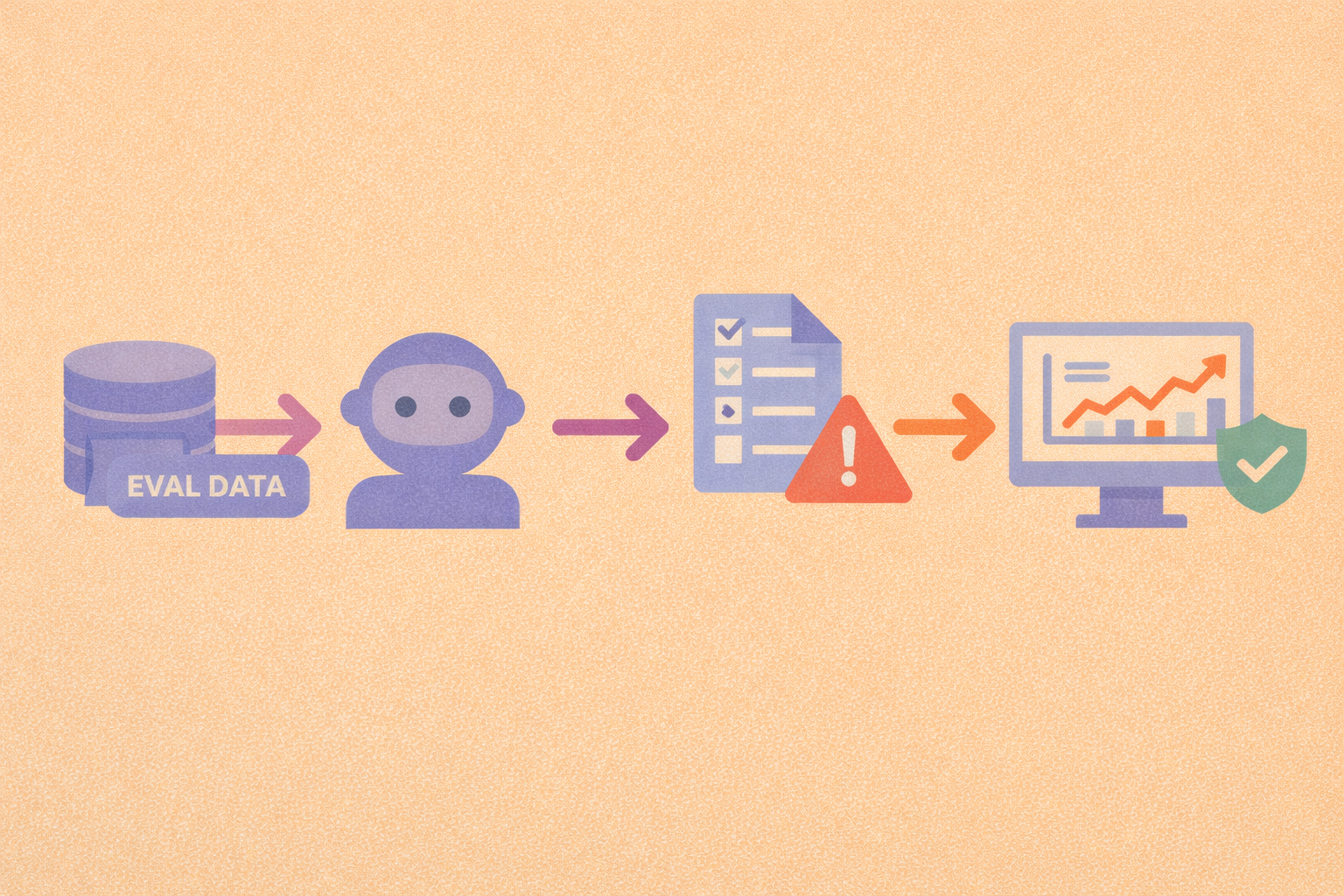
How to Set up AI Evaluation Pipelines in a Machine Learning Workflow
Evaluation pipelines turn model testing into a repeatable habit, making performance changes and failure patterns easier to catch early.
-
Few‑Shot Learning: Train AI with Just a Few Examples
Few‑shot learning empowers AI systems to generalize from only a handful of labeled samples. It's a game-changer for settings with limited data, slashing resource needs and accelerating deployment.
-
Step-by-step guide to AI evaluation in machine learning projects
A structured evaluation workflow helps you move from raw metrics to confident decisions about model quality, risk, and readiness.
-

Best AI evaluation platforms with collaboration features for teams
Once evaluation involves multiple reviewers and stakeholders, permissions, review workflows, and audit trails matter as much as the metrics.
-
How to Evaluate AI Models Effectively
AI model evaluation isn’t just about accuracy. Learn how to evaluate your models across key dimensions like reliability, bias, and real-world performance.
-
The Complete Guide to Evaluations in AI
Evaluating an AI model isn’t just about checking accuracy, it’s about building trust. This guide explores the full spectrum of evaluation methods, from metrics to human-in-the-loop reviews and LLM-based scoring.
-
ReCode Robustness Evaluation of Code Generation Models: What It Is and Why It Matters
What happens when a code generation model sees slightly modified inputs? ReCode is a benchmark designed to evaluate exactly that—how robustly these models handle variation in the wild.
-
How to Choose Evaluation Metrics for Accuracy and Speed
The right evaluation metrics make accuracy–speed tradeoffs visible so you can optimize for what actually matters in production.
-
Why Explainability Matters in AI Evaluation
This blog explores how explainability and interpretability fit into AI evaluations, helping teams build trust, spot hidden flaws, and ensure ethical performance.
-
AI Evaluation for NLP: What to Use (and When)
NLP evaluation often needs more than automated scores. This guide explains three common tool paths—structured human review, app-layer LLM evaluation, and programmable scoring—and when each fits best.
-
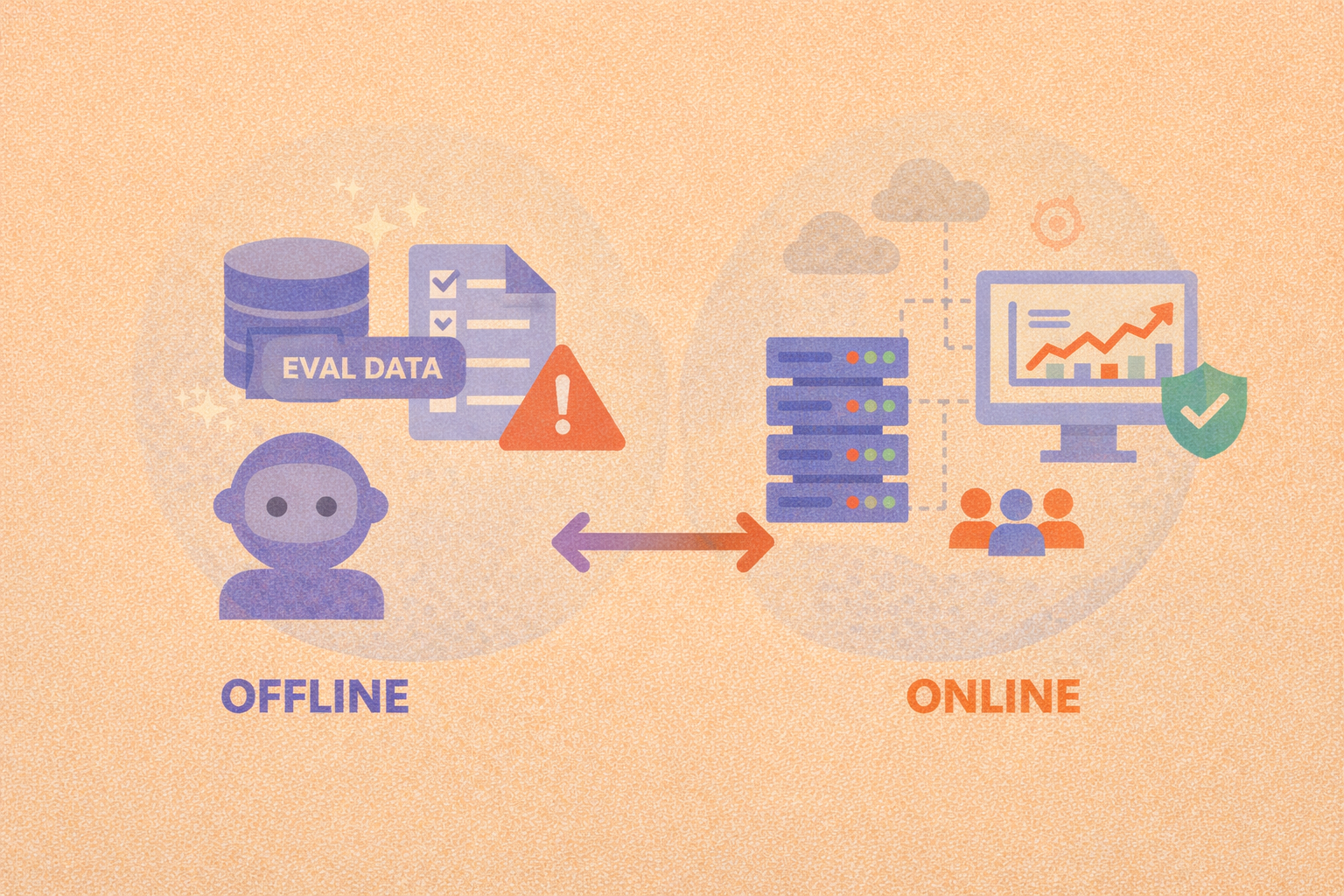
Offline evaluation vs online evaluation: when to use each
Offline evaluation enables fast, repeatable model comparison, while online evaluation confirms whether those gains hold up under real-world conditions.
-
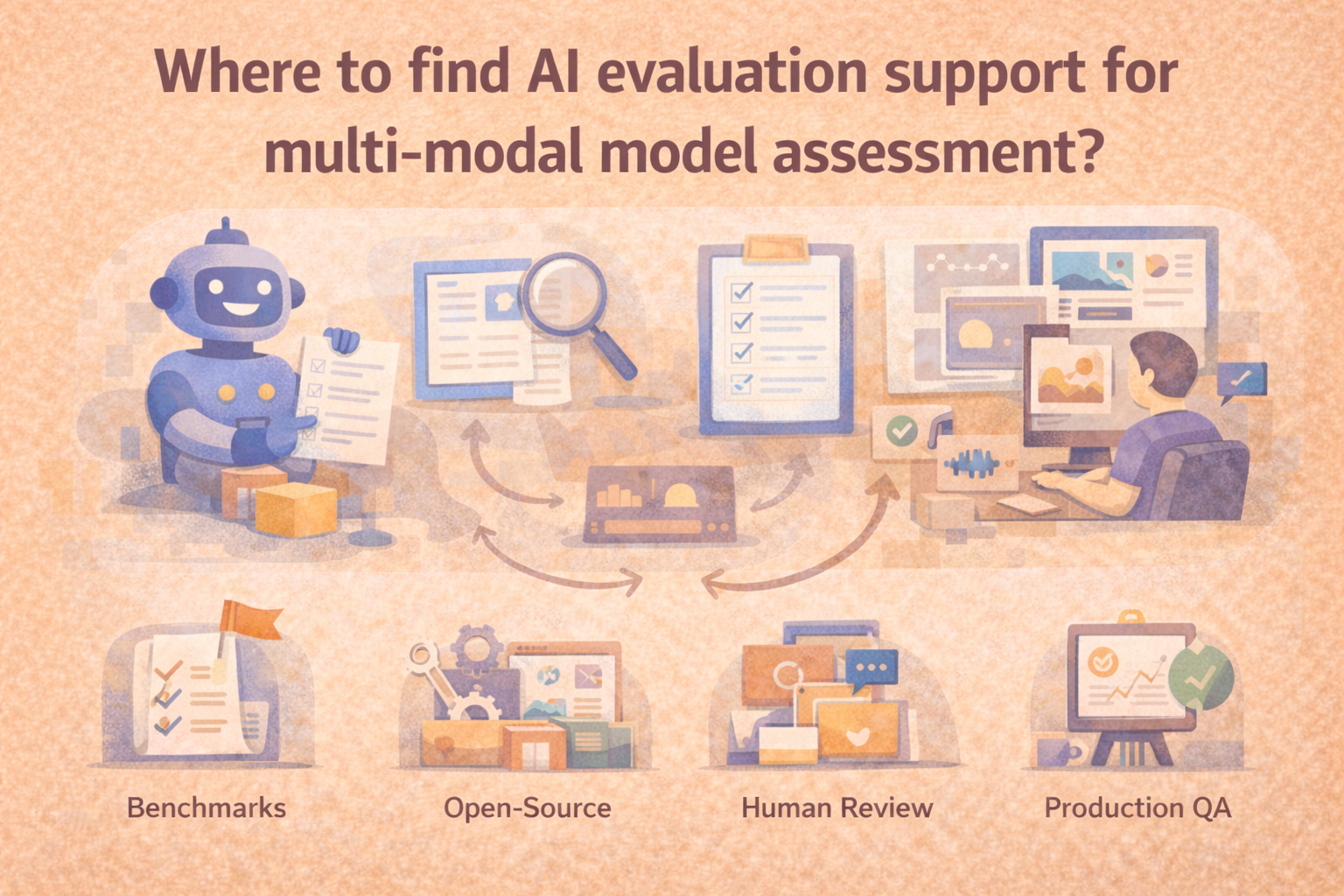
Where to find AI evaluation support for multi-modal model assessment
The right starting point depends on whether you need offline benchmarking, structured human review, regression testing, or real-world monitoring.
-
Human-in-the-Loop Evaluations: Why People Still Matter in AI
Human-in-the-loop (HITL) evaluations bring expert oversight into AI workflows. Learn where humans add value, how to scale review, and when it matters most.
Let me know if you'd like a hero image or a CTA linking this to your evaluations pillar page.
-
How to Automatically Catch Mistakes from Large Language Models
Evaluating the quality of large language model (LLM) outputs isn't one-size-fits-all. This guide breaks down four key methods, reference comparison, LLM-as-a-judge, rule-based checks, and classifiers, to help you automatically detect common errors like hallucinations, bias, and off-topic responses. Learn when and how to apply each method effectively.
-
AI Governance and Compliance: Why Evaluations Are the Missing Link
Without strong evaluation workflows, compliance with ethical and legal standards is impossible to verify, let alone enforce. Here’s how to close the gap.
-
This hub explores the full spectrum of evaluation methods, from metrics to human-in-the-loop reviews and LLM-based scoring across multiple articles.
-
Machine Learning Evaluation Metrics: What Really Matters?
Accuracy isn’t everything. Learn how precision, recall, F1 score, and more help you measure what really matters in machine learning model performance.
-
Understanding Model Accuracy: How to Evaluate Your AI
Accuracy is one of the most common metrics in machine learning evaluation, but it’s also one of the most misunderstood. Here’s how to use it wisely.
-
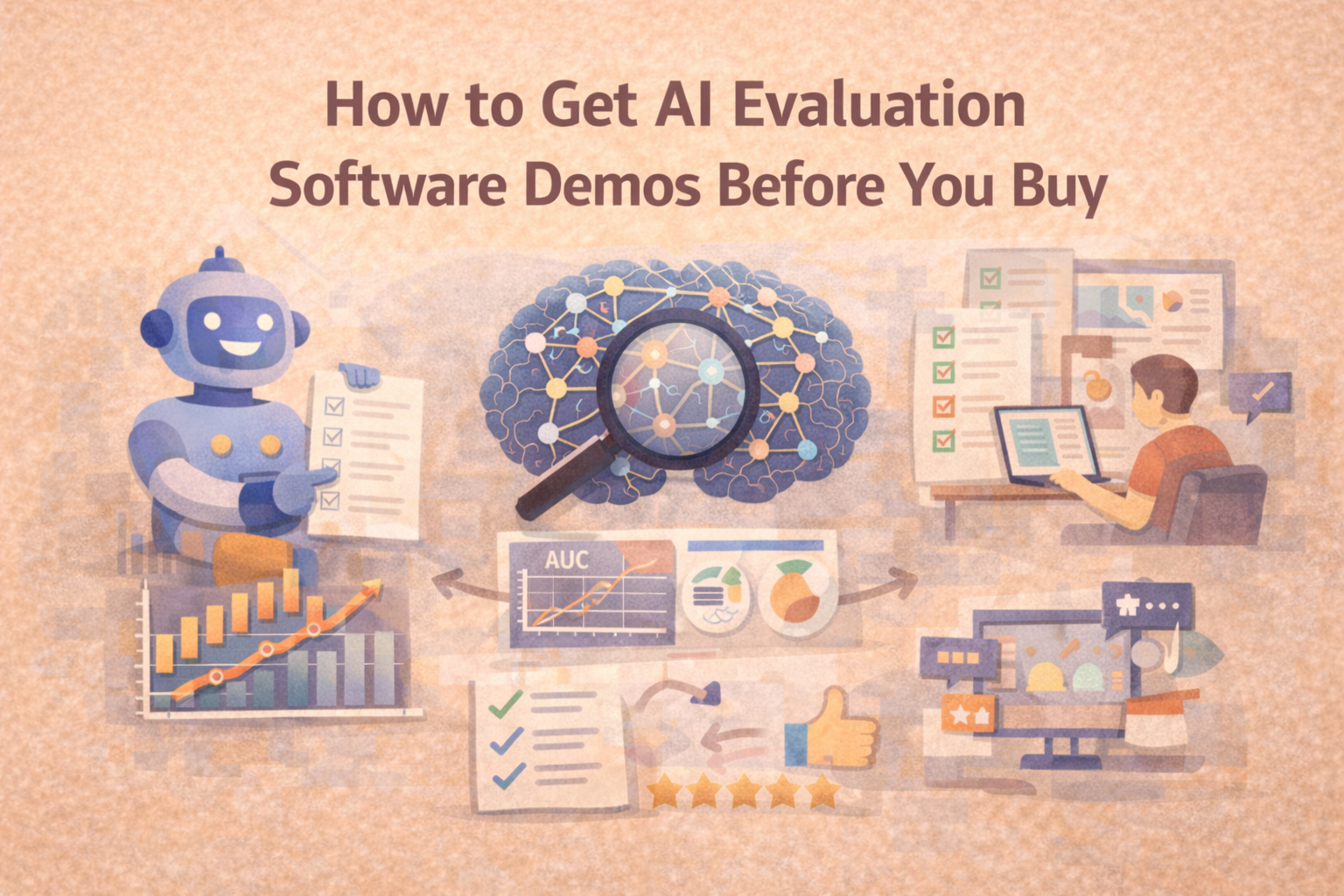
How to Get Demos of AI Evaluation Software Before You Buy
This guide explains how to prepare the right sample outputs, define structured review criteria, ask the right integration questions, and compare tools clearly before you buy.
-
How to Monitor AI Performance in Production: A Guide to Continuous Evaluation and Drift Detection
AI models don’t stop learning after deployment, but that doesn’t mean their performance stays reliable. This guide covers how to monitor your models in the real world, detect drift, and maintain accuracy over time.
-
Popular AI evaluation APIs for developers
AI evaluation APIs make it easier to run repeatable tests, track results over time, and catch regressions, as long as you design the workflow around versioning, traceability, and meaningful metrics.
-
What AI evaluation platforms specialize in assessing generative AI models?
GenAI evaluation works best when teams can review multi-turn outputs with consistent rubrics, shared workflows, and reliable governance.