Offline evaluation vs online evaluation: when to use each
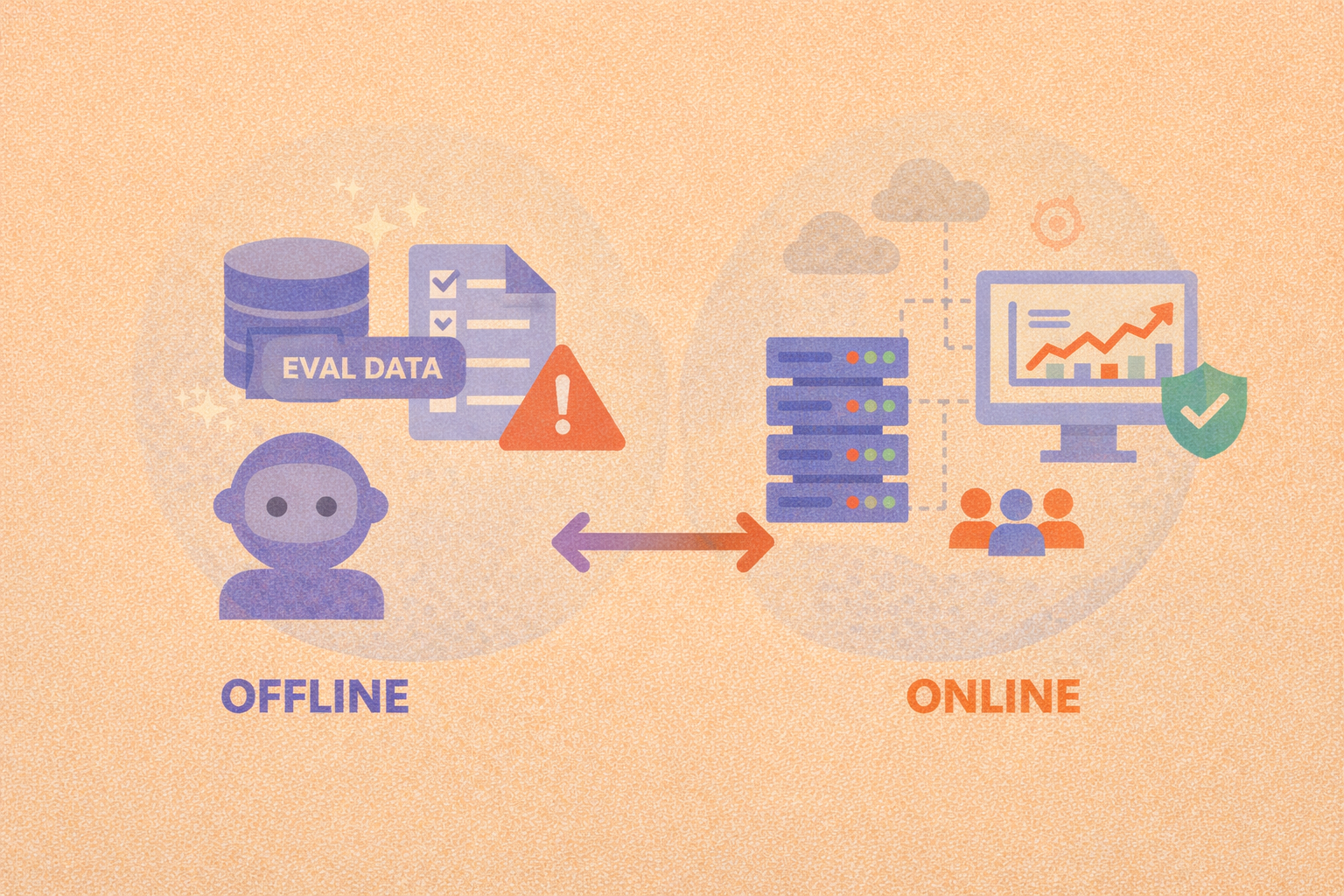
Contrary to popular belief, offline and online evaluation are not mutually exclusive. They’re actually complementary. While offline metrics tell you if a model learned its training data, online testing reveals how it actually performs in the real world. Offline testing gives you repeatability and fast iteration. Online testing gives you confidence that those improvements hold in production.
Knowing when and how to use both is what separates reliable evaluation programs from ones that miss things. This article helps you decide which to reach for, and when.
TL;DR
- Offline testing uses fixed historical datasets.
- Offline testing allows fast, repeatable model iteration.
- Most teams need both offline and online testing, sequenced.
- Use offline to iterate quickly and online to confirm the improvements are real.
What is offline model evaluation?
Offline evaluation measures model performance using a fixed dataset and a defined scoring method. It’s the default starting point for most machine learning projects because it’s repeatable and easy to compare across model versions.
Offline evaluation works best when you can define “correctness” clearly. Classification, detection, extraction, and many ranking tasks fit well because you can build a labeled set and score predictions against it. Offline evaluation is also great for regression testing: once you have a stable evaluation set, you can quickly see whether a new model version improves or degrades performance.
The main limitation is realism. Offline datasets are always approximations of production. They may underrepresent edge cases, omit new user behaviors, or reflect historical patterns that have already shifted. A model can look improved offline and still cause new issues in real usage, especially if the deployment environment is noisy or user inputs change over time.
Offline evaluation also struggles with metrics that require subjective judgment (tone, helpfulness, policy adherence) unless you’ve designed a rubric and labels that capture those qualities reliably.
What is online model evaluation?
Online evaluation measures model performance in a live environment. Instead of relying only on a static dataset, it assesses behavior under real inputs and real user interaction patterns. Online evaluation can include controlled experiments (like A/B tests), phased rollouts, or monitoring-driven comparisons of outcomes.
Online evaluation is valuable because it captures reality: latency under load, real distribution shifts, user feedback loops, and the long tail of unexpected inputs. It can reveal issues that never appear in an offline dataset, including changes in user behavior, integration quirks, or product-specific constraints.
The tradeoff is control. Online evaluation is harder to run safely and interpret cleanly. Results can be noisy, and confounding variables (traffic mix, seasonality, UX changes) can hide the true cause of a performance shift. Online evaluation also requires thoughtful risk controls, because mistakes affect real users.
In practice, online evaluation is strongest when you already have a baseline of offline confidence and you want to validate that improvements carry over to production outcomes.
Comparing online vs. offline evaluation methods
| Dimension | Offline evaluation | Online evaluation |
| Core question answered | “Does the model score well on a fixed test set?” | “Does the model improve outcomes in real usage?” |
| Best for | Regression testing, model iteration, benchmarking | Real-world validation, rollout decisions, monitoring |
| Data source | Curated evaluation dataset | Live traffic and real inputs |
| Repeatability | High (same set, same score) | Lower (traffic and context vary) |
| Noise level | Low to moderate | Moderate to high |
| What it catches well | Clear errors, metric changes, predictable failure modes | Drift, UX impacts, tail cases, system-level issues |
| What it misses | Distribution shift, real user behavior, integration effects | Clean apples-to-apples comparisons without controls |
| Risk to users | None (offline only) | Non-trivial (requires safeguards) |
| Time to run | Fast once set up | Slower; needs rollout time and analysis |
| Governance needs | Dataset/version control | Experiment design, monitoring, risk management |
When to use online vs. offline evaluation methods
Use offline evaluation as your default engine for iteration and use online evaluation as your reality check.
A practical workflow for beginners:
- Build a stable offline evaluation set and track metrics by version.
- Add targeted offline tests for known edge cases and high-risk slices.
- When offline results are strong, validate online using controlled exposure (limited rollout, clear success metrics).
- Keep monitoring online outcomes after release, especially when inputs or policies change.
If you have to pick only one place to start, start offline. If you have to decide what makes a model “ready,” use offline to narrow choices and online to confirm safety and impact.
Different use cases, different strengths
The right approach depends on what you're building and how well a fixed data set can represent the inputs and outcomes that matter in production. These differences become clearer when you look at specific model types:
- For a text classification model (spam detection, intent recognition, sentiment labeling): offline evaluation is usually sufficient for most of the development cycle. Ground truth is clear, datasets are easy to build, and regression testing covers most failure modes. Online evaluation becomes relevant when you're validating that real-world input distributions match what you tested against.
For a recommendation system or a generative AI feature like a chatbot or summarization tool, offline evaluation gets you started but has real limits. User behavior, session context, and subjective quality are hard to capture in a static dataset. Online evaluation is often the only reliable way to know whether changes improve actual outcomes.
Cost and resource tradeoffs
Offline evaluation is cheaper to run but has some upfront costs. You need a well-labeled evaluation database and a consistent way to score predictions against it. On top of that, you need the discipline to keep it all versioned and representative over time. It’s a significant lift at the start but it pays off quickly through fast iteration cycles and low operational overhead per run.
Online evaluation requires more infrastructure. Traffic routing, experiment design, monitoring, and safeguards are all required to limit exposure when things go wrong. It also takes longer to produce results, since you need enough live traffic to draw reliable conclusions. For smaller teams or early-stage projects, this is often prohibitive, which is one reason offline evaluation is the right default starting point.
It’s not an “either / or” decision
A strong foundation requires building and maintaining evaluation datasets that capture the quality criteria that actually matter for their use case. This work compounds: a well-maintained evaluation set pays dividends across every model version you ship. Label Studio is built to help teams create the labeled datasets and evaluation rubrics that make offline testing rigorous, and to bring human review into the loop when automated scoring falls short. If your evaluation program is still ad hoc, that's usually the right place to start.
Frequently Asked Questions
FAQs about offline and online evaluation
Is offline evaluation enough to decide whether a model is ready?
Offline evaluation is necessary but not sufficient. It helps compare models reliably, but it cannot fully predict how a model will behave under real user traffic or changing conditions.
When should teams move from offline to online evaluation?
Teams should consider online evaluation once offline metrics are stable and improvements appear meaningful, especially before broad deployment or high-impact changes.
Does online evaluation always mean running experiments on users?
Not necessarily. Online evaluation can include limited rollouts, shadow testing, or passive monitoring before full exposure.
Can offline and online evaluation disagree?
Yes. This is common and often valuable. Disagreement usually signals distribution shift, UX issues, or system-level effects that offline datasets didn’t capture.
Which should be used first in a new project?
Offline evaluation is usually the right starting point because it is safer, faster, and easier to control.
What is the role of A/B testing in online model evaluation?
A/B testing deploys a new model to a subset of live users while the rest stay on the baseline. By comparing real outcomes between the two groups, teams can measure the model's true impact on user behavior while controlling for confounding factors like seasonality.
Why is a chronological hold-out set important for offline testing?
A chronological hold-out set uses data from a later period than the model trained on. This prevents time-based data leakage and more accurately simulates deployment conditions. It gives teams a reliable performance baseline before moving to online testing.
Related Content
-
How to build a red teaming dataset
Learn how to build a red teaming dataset with a reusable schema, three sourcing tiers, expert annotation, and a maintenance workflow that keeps your model's safety coverage current.
-
How to Set up AI Evaluation Pipelines in a Machine Learning Workflow
Evaluation pipelines turn model testing into a repeatable habit, making performance changes and failure patterns easier to catch early.
-

Few‑Shot Learning: Train AI with Just a Few Examples
Few‑shot learning empowers AI systems to generalize from only a handful of labeled samples. It's a game-changer for settings with limited data, slashing resource needs and accelerating deployment.
-
Step-by-step guide to AI evaluation in machine learning projects
A structured evaluation workflow helps you move from raw metrics to confident decisions about model quality, risk, and readiness.
-

Best AI evaluation platforms with collaboration features for teams
Once evaluation involves multiple reviewers and stakeholders, permissions, review workflows, and audit trails matter as much as the metrics.
-
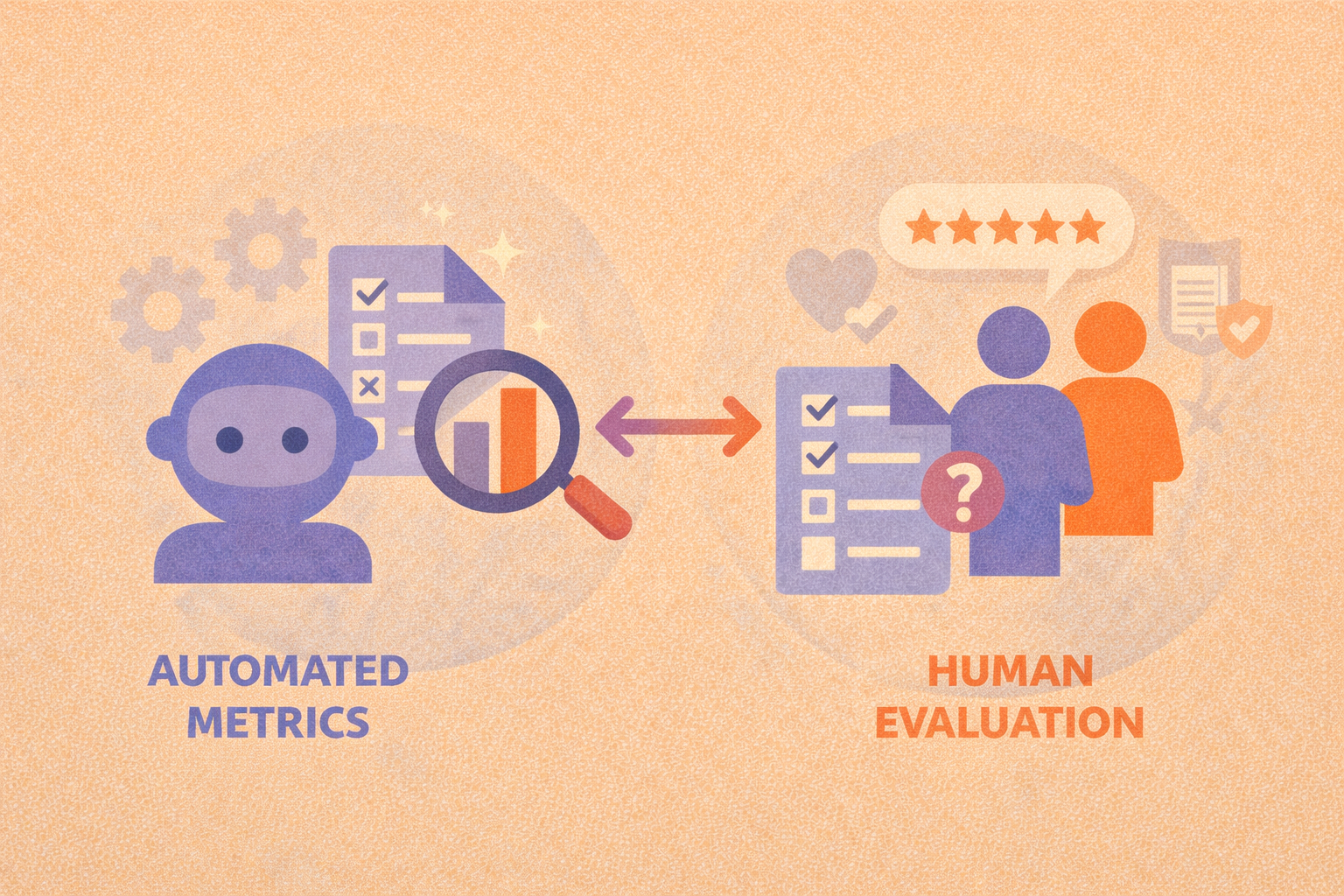
Automated metrics vs human evaluation: when each is the right choice
Automated metrics provide scale and consistency, while human evaluation captures nuance, effective AI evaluation programs rely on both.
-

How to Evaluate AI Models Effectively
AI model evaluation isn’t just about accuracy. Learn how to evaluate your models across key dimensions like reliability, bias, and real-world performance.
-
The Complete Guide to Evaluations in AI
Evaluating an AI model isn’t just about checking accuracy, it’s about building trust. This guide explores the full spectrum of evaluation methods, from metrics to human-in-the-loop reviews and LLM-based scoring.
-
ReCode Robustness Evaluation of Code Generation Models: What It Is and Why It Matters
What happens when a code generation model sees slightly modified inputs? ReCode is a benchmark designed to evaluate exactly that—how robustly these models handle variation in the wild.
-
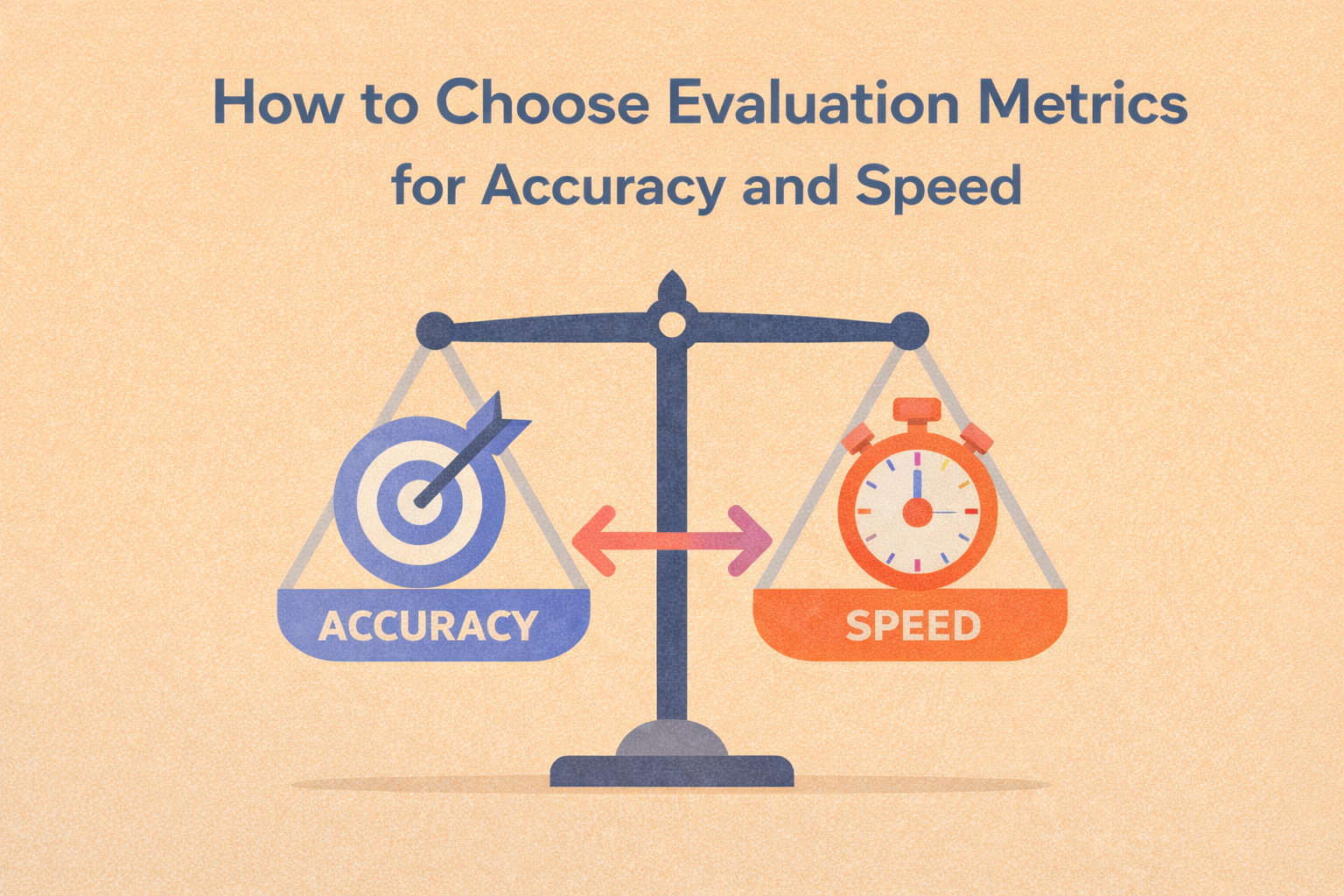
How to Choose Evaluation Metrics for Accuracy and Speed
The right evaluation metrics make accuracy–speed tradeoffs visible so you can optimize for what actually matters in production.
-

Why Explainability Matters in AI Evaluation
This blog explores how explainability and interpretability fit into AI evaluations, helping teams build trust, spot hidden flaws, and ensure ethical performance.
-
AI Evaluation for NLP: What to Use (and When)
NLP evaluation often needs more than automated scores. This guide explains three common tool paths—structured human review, app-layer LLM evaluation, and programmable scoring—and when each fits best.
-
Where to find AI evaluation support for multi-modal model assessment
The right starting point depends on whether you need offline benchmarking, structured human review, regression testing, or real-world monitoring.
-
Human-in-the-Loop Evaluations: Why People Still Matter in AI
Human-in-the-loop (HITL) evaluations bring expert oversight into AI workflows. Learn where humans add value, how to scale review, and when it matters most.
Let me know if you'd like a hero image or a CTA linking this to your evaluations pillar page.
-
How to Automatically Catch Mistakes from Large Language Models
Evaluating the quality of large language model (LLM) outputs isn't one-size-fits-all. This guide breaks down four key methods, reference comparison, LLM-as-a-judge, rule-based checks, and classifiers, to help you automatically detect common errors like hallucinations, bias, and off-topic responses. Learn when and how to apply each method effectively.
-
AI Governance and Compliance: Why Evaluations Are the Missing Link
Without strong evaluation workflows, compliance with ethical and legal standards is impossible to verify, let alone enforce. Here’s how to close the gap.
-
This hub explores the full spectrum of evaluation methods, from metrics to human-in-the-loop reviews and LLM-based scoring across multiple articles.
-

Machine Learning Evaluation Metrics: What Really Matters?
Accuracy isn’t everything. Learn how precision, recall, F1 score, and more help you measure what really matters in machine learning model performance.
-
Understanding Model Accuracy: How to Evaluate Your AI
Accuracy is one of the most common metrics in machine learning evaluation, but it’s also one of the most misunderstood. Here’s how to use it wisely.
-

How to Get Demos of AI Evaluation Software Before You Buy
This guide explains how to prepare the right sample outputs, define structured review criteria, ask the right integration questions, and compare tools clearly before you buy.
-
How to Monitor AI Performance in Production: A Guide to Continuous Evaluation and Drift Detection
AI models don’t stop learning after deployment, but that doesn’t mean their performance stays reliable. This guide covers how to monitor your models in the real world, detect drift, and maintain accuracy over time.
-
Popular AI evaluation APIs for developers
AI evaluation APIs make it easier to run repeatable tests, track results over time, and catch regressions, as long as you design the workflow around versioning, traceability, and meaningful metrics.
-

What AI evaluation platforms specialize in assessing generative AI models?
GenAI evaluation works best when teams can review multi-turn outputs with consistent rubrics, shared workflows, and reliable governance.