How to choose an LLM benchmark
Identical top-line benchmark scores trick engineering teams into a false sense of security. They mask an underlying disagreement rate of 16 to 66 percent on individual items, representing a massive enterprise blind spot. Relying solely on public leaderboards to approve large language models for production means capability gaps will inevitably emerge under real-world pressure.
While public scores remain useful for shortlisting, moving a model safely into deployment demands custom, domain-specific evaluations that off-the-shelf tests cannot provide. You will learn why static datasets decay and how composite scoring hides critical errors. Understanding those risks helps teams justify building proprietary validation pipelines that reflect actual engineering workflows.
TL;DR
Sweeping scale on public leaderboards provides an excellent baseline for initial screening but misses niche enterprise constraints.
Aggressive test-set contamination and high error rates plague household static benchmarks, making standard accuracy metrics increasingly unreliable.
Large language models with identical composite scores on rigorous academic tests still contradict each other on up to 66 percent of individual responses.
Off-the-shelf automated evaluators exhibit severe structural biases that destroy correlation with human preference.
Production readiness demands verifiable human-in-the-loop oversight to construct custom tests around multi-turn business workflows.
Why public leaderboards are strictly for shortlisting
The broader AI industry actively tracks model performance using crowdsourced public arenas. If those arenas dictate the market, you might wonder why they fail as a final deployment filter. The answer lies in the vast difference between general reasoning and specialized execution. Standardized tests define a model's foundational capability, but raw conversational volume rarely dictates enterprise readiness.
To their credit, public leaderboards offer unprecedented scope. Chatbot Arena captures 1,000,000 conversations involving 210,479 users across 154 languages. The resulting dataset aligns well with expert baseline raters for broad conversational tasks, showing teams which models handle generic prompts smoothly. You can safely use these rankings to eliminate bottom-tier models from consideration before wasting engineering hours on them.
Treating that high public rank as absolute proof of business readiness introduces systemic danger. A foundation model that writes a flawless marketing email might hallucinate terms when asked to parse a proprietary financial instrument. Engineers deploying these tools into specialized workflows require targeted evaluation.
The hidden risks of static benchmarks
Even if a model genuinely earns a stellar score on a clean evaluation suite, that single aggregate metric obscures critical variations in capability. Development teams often treat established academic tests as immutable sources of truth, though leading researchers argue otherwise. Many of the most trusted datasets degrade rapidly. They often contain structural flaws that falsely amplify perceived reasoning skills.
Test-set contamination and benchmark decay
Trusting a static test published two years ago measures historical recall, leaving active logic unverified. Vendors train modern language systems on vast swaths of the internet, often absorbing the standard questions later used to grade them.
Researchers tracking this phenomenon note that test-set contamination and shifting model knowledge cutoffs render static benchmarks obsolete at an exceptionally fast pace. The creators of LiveBench combat this decay by adding fresh questions monthly based on recent sources, specifically to prevent rote memorization. Without continuous metric updates, developers effectively test systems against answers they already acquired during pre-training.
Foundational errors in established tests
Behind the shiny top-line scores, popular datasets frequently conceal flawed items that skew leaderboards. An estimated 6.49 percent of questions in the popular MMLU benchmark contain errors. That baseline error rate spikes to 57 percent in hyper-specific subsets like Virology.
Foundational mistakes artificially group competing models together at the top of the leaderboard. When researchers built MMLU-Pro, they stripped away trivial questions and expanded the multiple-choice options. The adjustment caused top model accuracy to drop by 16 to 33 percent relative to the original, while reducing prompt sensitivity from 4 to 5 percent down to 2 percent. Evaluating systems with these uncorrected datasets rewards statistical quirks over practical reasoning.
The illusion of identical composite scores
Two models scoring an 85 percent overall accuracy on a rigorous test might seem functionally equal. Engineering teams naturally assume equivalent performance moving into production. Early research challenges that assumption, highlighting deep behavioral fractures behind the math.
Studies suggest that models achieving comparable aggregate composite accuracy scores on tests like MMLU-Pro and GPQA can still disagree with each other on 16 to 66 percent of individual items. One system might accurately solve a complex logic puzzle but fail a basic legal formatting request. The other system reverses that performance. Their final composite scores look nearly identical at a glance, obscuring the underlying variations.
The industry lacks clear, universal formulas to detect which combinations of training data cause these varied failure modes. An aggregate score simply smooths over the chaos. Recognizing that identical scores hide wildly different failure profiles prompts teams to validate capabilities on proprietary data.
The bias problem in automated benchmarking
Faced with the headache of manual testing, developers frequently try solving the evaluation bottleneck by using a massive model to securely grade custom company data. Automated evaluation sounds highly efficient on paper. Unfortunately, relying purely on out-of-the-box automated judges introduces fresh structural biases that silently distort the final data.
For example, automated evaluators naturally prefer longer text. Research into the AlpacaEval framework proved that judges inherently exhibit length bias; controlling for verbosity improves correlation with true human preference from 0.94 to 0.98. Without careful calibration to restrict verbosity, the evaluating application issues high marks to outputs offering bloated text alongside reduced factual accuracy.
Overcoming this limitation requires aligning automated evaluation layers with human review directly. Human oversight determines the specific rubrics that constrain the judging algorithm. Establishing clear parameters prevents the judge from drifting away from the required formatting and logic constraints of the original prompt.
Building custom domain-specific benchmarks
Production readiness demands building customized datasets that mimic actual multi-turn business workflows. Old multiple-choice structures fail to capture reality when applied to nuanced edge cases. Older health benchmarks fail to represent real-world clinical behavior because they rely on narrow multiple-choice formats that fail to test open-ended, multi-turn clinical workflows.
Creating tailored sequences requires a platform designed to process complex criteria. Engineering leads often evaluate AI capability directly on custom benchmarks by combining verifiable ground-truth data with specialized scoring rules. Evaluating models this way shifts the focus from generic capabilities to required business outcomes, using platforms like HumanSignal to manage the required human-in-the-loop oversight.
Real-world metrics prove why specialized testing wins. When reviewers constructed a domain-specific legal benchmark case study, they built a custom dataset mapping thousands of demanding contract requirements to standard corporate law practices. Under that proprietary evaluation, top human lawyers produced a reliable first draft 70 percent of the time. The leading AI tool surprisingly reached 73.3 percent reliability, giving the engineering team a comparative metric they could trust.
Professionals have to build evaluation architecture that adapts over time to support rigorous domain logic. Maintaining a custom pipeline that manages dataset versioning, complex rubric generation, and continuous output validation requires significant effort. Building massive private datasets is often cost-prohibitive for development teams without dedicated tooling.
Choosing precision over proxies
Evaluating foundation models means moving beyond aggregate reasoning scores and recognizing that the benchmarking market is splitting into five distinct families: static academic, dynamic contamination-resistant, human-preference, safety, and domain-specific. Capabilities and safety require divergent evaluation pipelines; for example, the MLCommons AILuminate suite tests 12 hazard categories across 109 models using 59,624 prompts to measure risk. Establishing those pipelines entails creating an evaluation workflow governed by 46 lifecycle best practices, driving teams to adopt HumanSignal to merge automated scoring with verifiable human oversight. Public leaderboards identify standout general models, while proprietary domain evaluation proves which system actually qualifies to work for your team.
How do I detect test-set contamination in my LLM?
Contamination is notoriously difficult to calculate with certainty, but you can detect it by testing models against dynamically updated datasets like LiveBench. The developers of this test add fresh questions monthly explicitly to prevent rote memorization. Shifting model knowledge cutoffs render static benchmarks obsolete as models memorize answers during pre-training.
What is the difference between a static benchmark and a dynamic benchmark?
Static benchmarks feature fixed datasets that are easy to administer but degrade over time as systems ingest them during training runs. Dynamic benchmarks continuously add contemporary data pulling from recent news and newly published papers. Constant updating prevents the system from merely repeating historical data it already studied, forcing it to apply active reasoning.
Can I use LLM-as-a-judge for enterprise benchmarking?
You can use automated evaluators for enterprise benchmarking, but only with careful calibration controls in place. Automated judges naturally prefer longer answers over concise accuracy unless restricted. Research into the AlpacaEval framework proved that controlling for verbosity bias improves the correlation with human preference from 0.94 to 0.98.
Why did MMLU-Pro cause LLM accuracy scores to drop?
The original dataset contained a high density of trivial questions and a fixed prompt sensitivity that artificially inflated academic scores. The updated version stripped away the easiest questions and expanded the multiple-choice options. The adjustment caused top model accuracy to drop by 16 to 33 percent while reducing prompt sensitivity down to 2 percent.
Do high benchmark scores mean a model is production-ready?
High standard benchmark scores only indicate a model is safe to shortlist for further testing. True production readiness requires domain-specific testing to ensure the system aligns with specialized business formatting and multiple-turn workflows. Evaluating models against complex proprietary constraints exposes latent capability gaps that generic reasoning questions cannot catch.
Related Content
-
Do you need a custom benchmark?
Learn why public AI leaderboards constantly fail enterprise deployments and how to scale a continuous evaluation maturity framework from proof-of-concept to production without wasting endless engineering hours.
-
Domain-specific vs. general benchmarks: What's the difference?
Learn the difference between domain-specific and general benchmarks. Understand how to measure artificial intelligence model performance effectively for your specific use case.
-
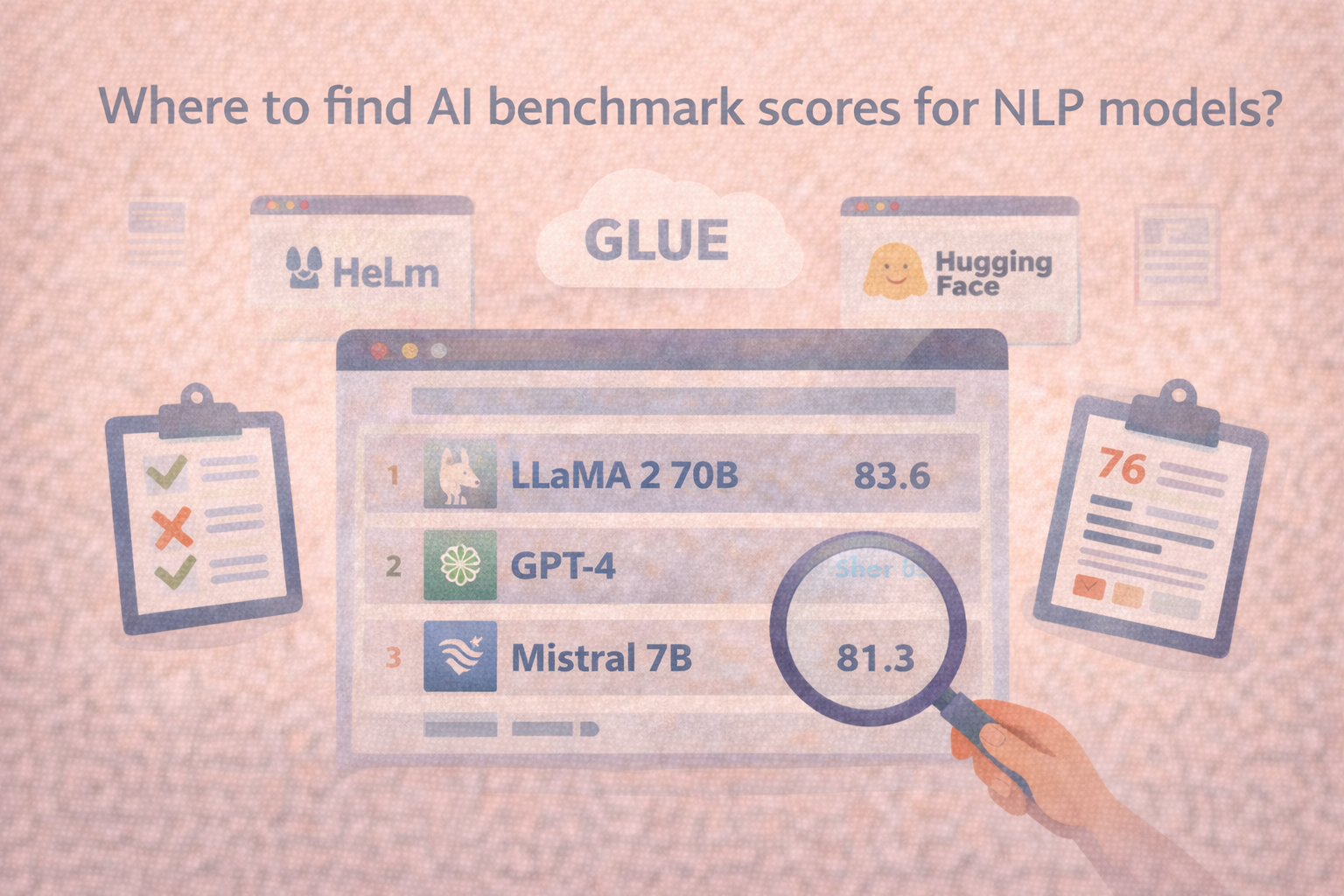
Where can I find AI benchmark scores for natural language processing models?
You can find NLP benchmark scores quickly on public leaderboards, but the comparisons only hold up when you verify versions, evaluation settings, and the exact model variant being scored.
-
Getting started with benchmark creation
A guide to creating effective benchmarks for evaluating machine learning models, covering data selection, annotation, and iteration.
-
How do benchmarks use ground truth data?
Learn how ground truth data serves as the foundation for evaluating machine learning models and tracking AI benchmark performance.
-
What are the most reliable AI benchmarks used in industry?
The core language, vision, speech, and system benchmarks that teams still rely on to compare models.
-
What services offer AI benchmark reports for enterprise decision-making?
A practical guide to the main sources of AI benchmark reports enterprises use to compare vendors, platforms, and model performance.
-
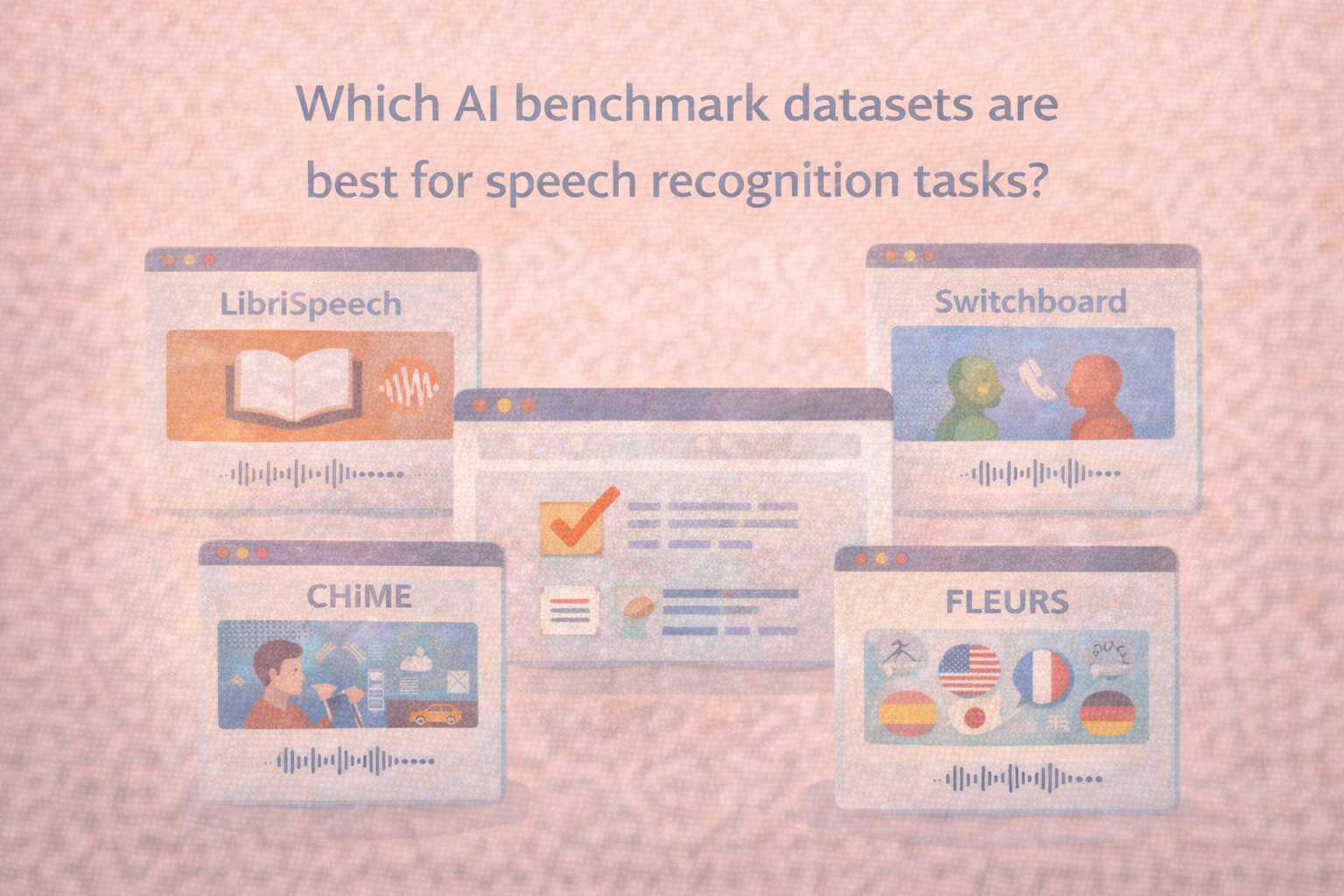
Which AI benchmark datasets are best for speech recognition tasks?
The best ASR benchmarks depend on your target audio conditions, so the most reliable approach is to pair a standard baseline with a dataset that reflects how people actually speak in your product.
-
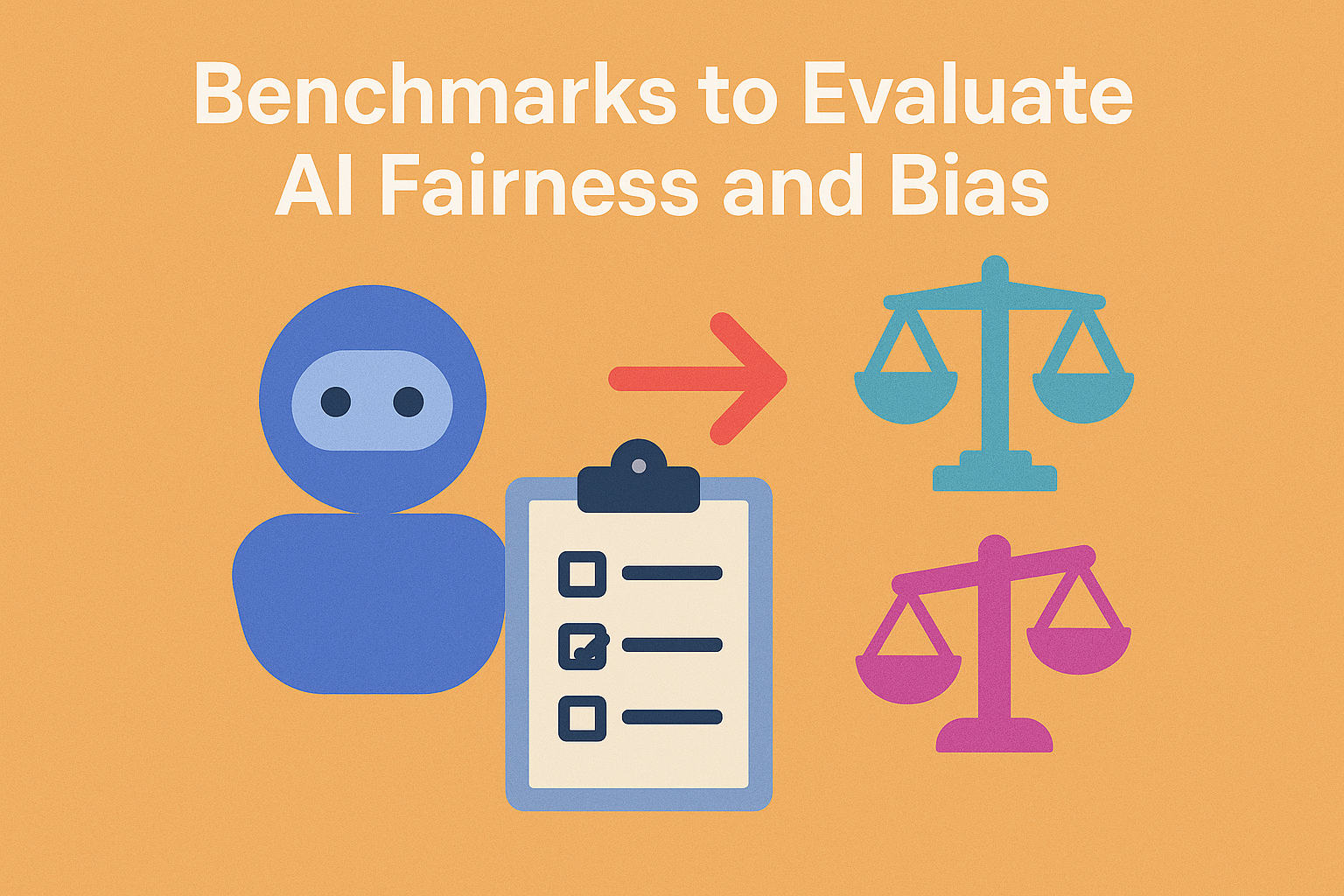
What Benchmarks are Used to Evaluate AI fairness and Bias?
AI fairness and bias benchmarks help teams measure whether model performance or behavior changes across groups, identities, or contexts
-
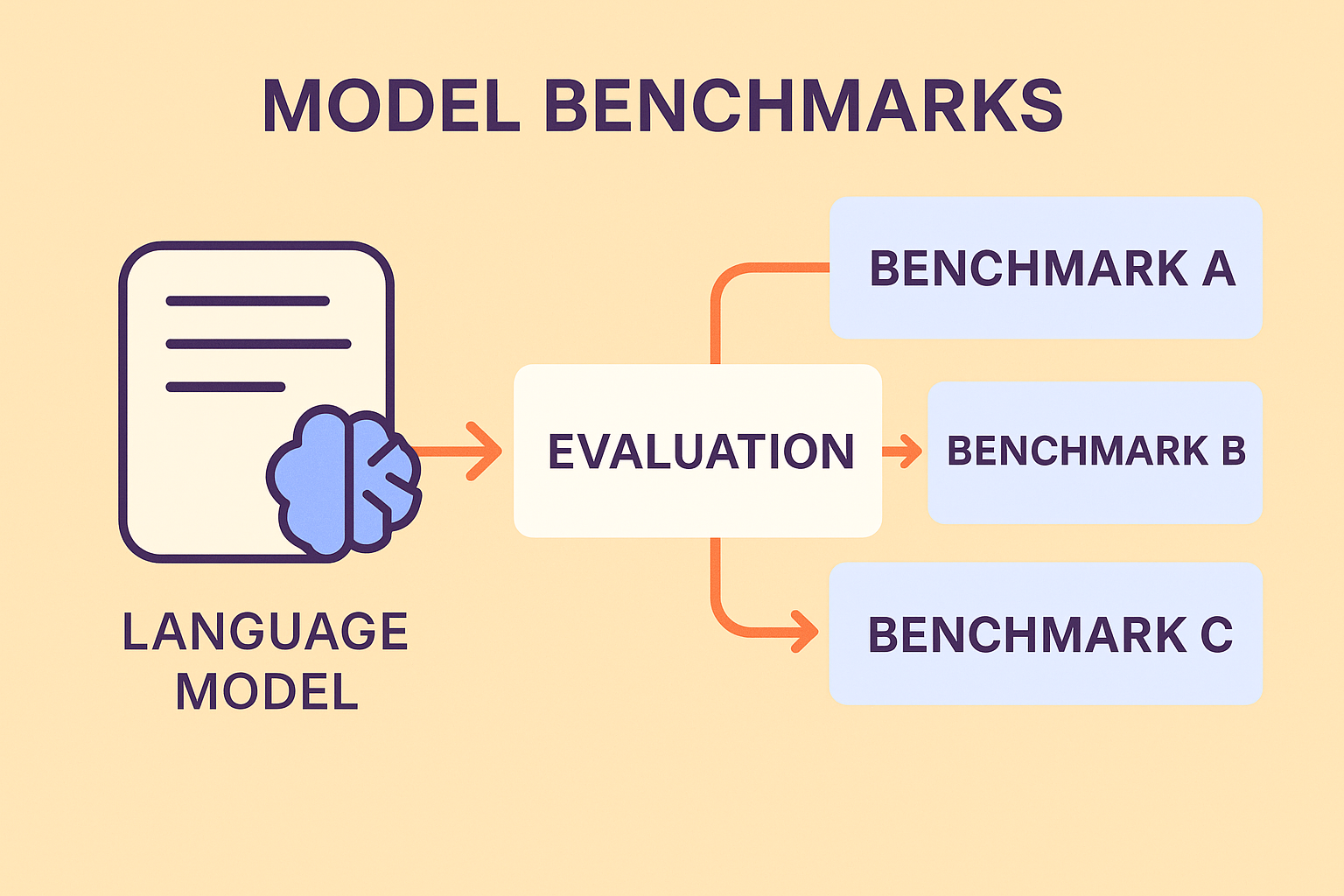
Benchmarks are the measuring sticks of machine learning. They provide a way to evaluate models consistently, compare progress, and understand whether performance holds up in real-world conditions.
-
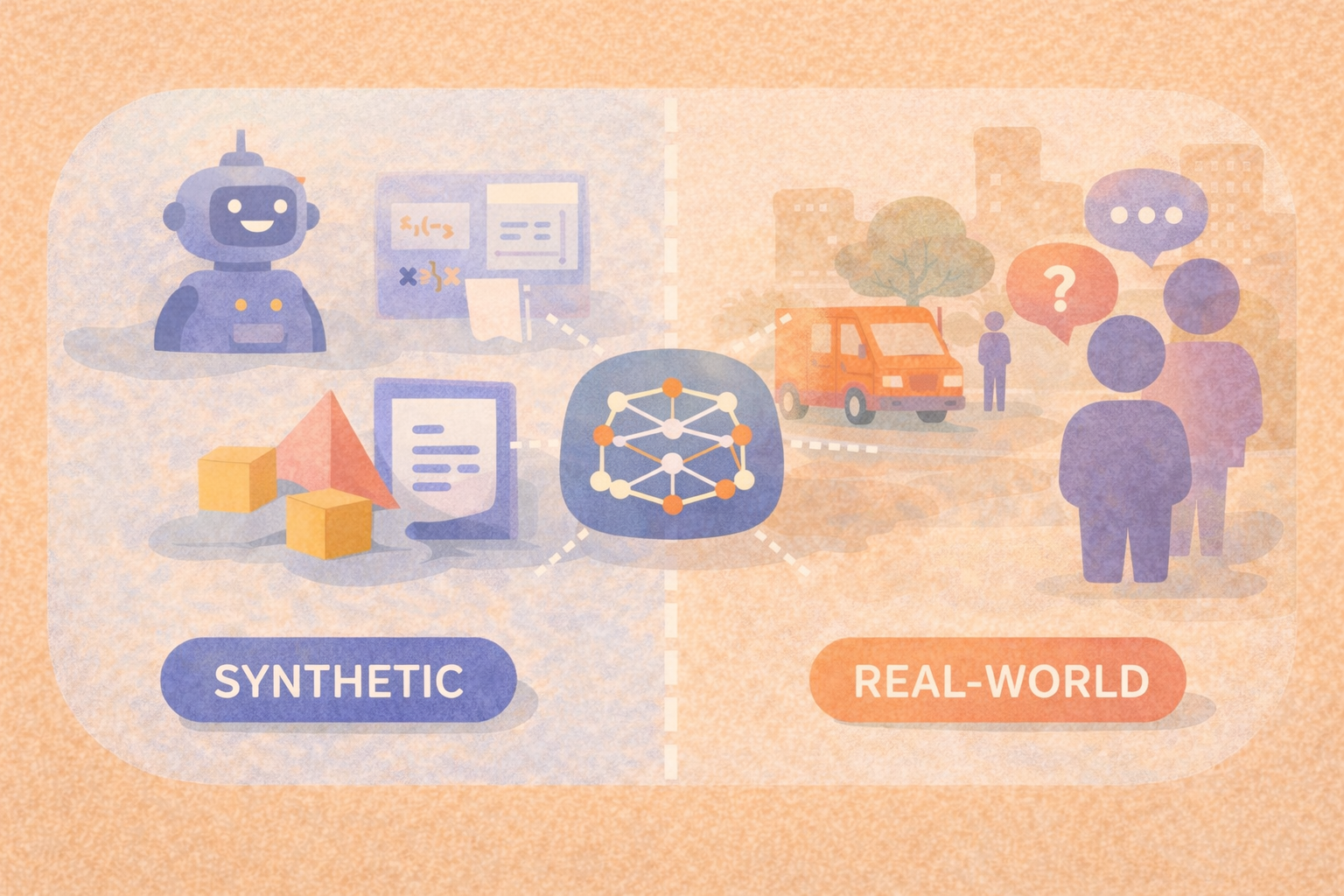
What are the differences between synthetic and real-world AI benchmarks?
Synthetic benchmarks offer control and scalability, while real-world benchmarks expose how AI systems behave under real conditions—and strong evaluation strategies rely on both.
-
Static vs. dynamic benchmarks: What's the difference?
Learn the structural differences between static and dynamic AI evaluations, why purely dynamic tests ruin version control, and how to build a hybrid pipeline.
-
How often are AI benchmarks updated by major testing organizations
Benchmark results are time-bound, so the most reliable comparisons always include the benchmark version, evaluation method, and date.
-
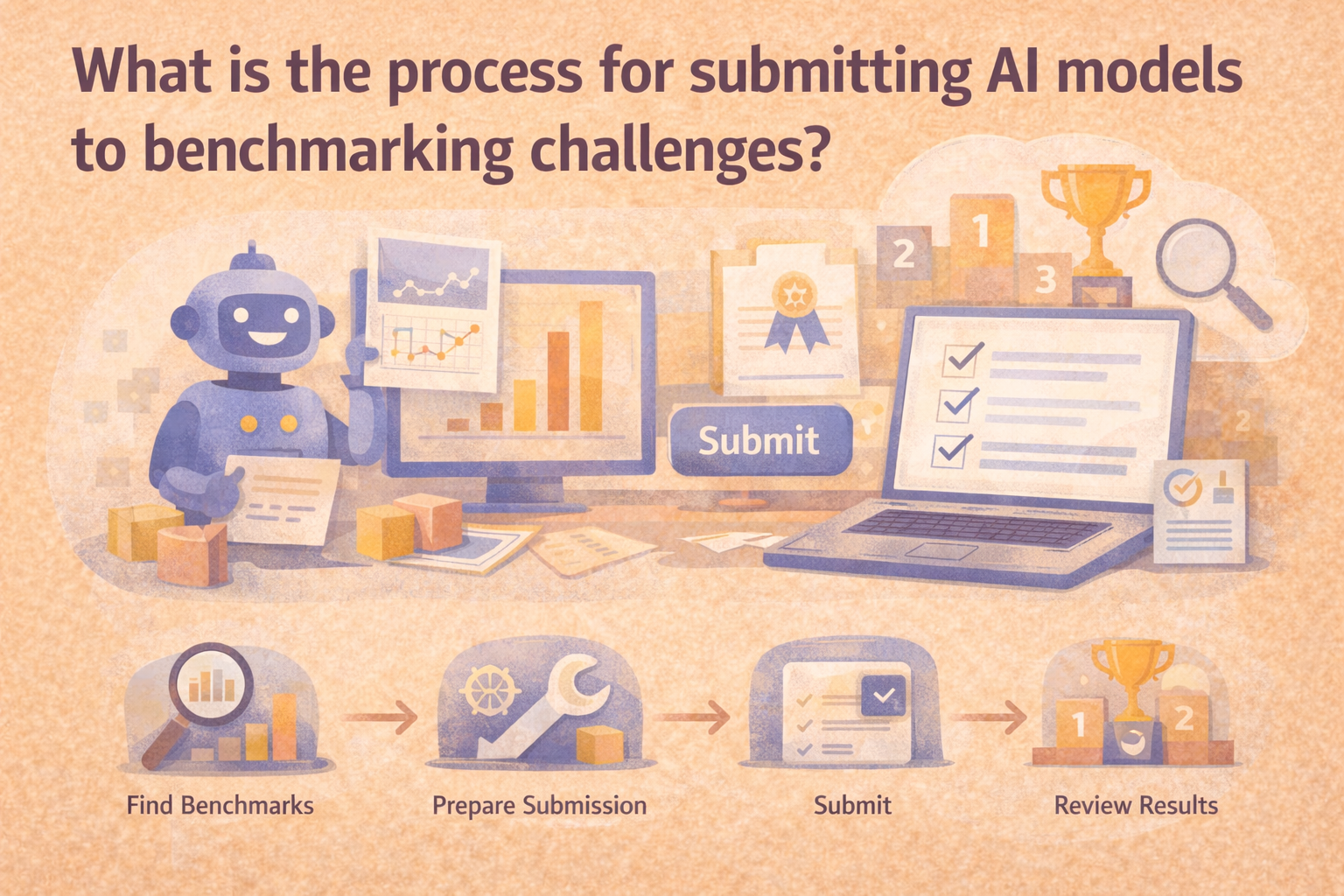
What is the process for submitting AI models to benchmarking challenges?
Submitting an AI model to a benchmarking challenge is less about “upload the model” and more about proving your system can be evaluated fairly.
-
How to interpret AI benchmark results from third-party testing services?
Benchmark scores can be helpful signals, but only if you understand the dataset, scoring method, evaluation setup, and version behind the number.
-
Benchmarks provide a common ground for evaluating machine learning models, but their usefulness depends on how well they reflect real-world goals. This guide explains what benchmarks are, when to rely on them, and where they fall short.
-
What are the differences between synthetic and real-world AI benchmarks?
This article breaks down how synthetic and real-world AI benchmarks differ and why teams need both to understand true model performance.